
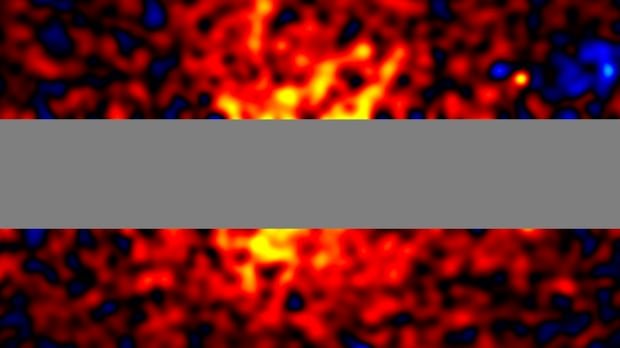
A researcher at the University of Tokyo claims to have visually captured a portion of the invisible universe that makes up 95% of our cosmos. Dark energy, constituting around 68% of the universe, drives its accelerating expansion, while dark matter, making up 27%, prevents galaxies from dispersing.
Dark matter and dark energy are unseen entities that manifest their presence through interactions with observable objects like galaxies. Astronomer Fritz Zwicky first hypothesized dark matter’s existence in 1933 to explain why galaxies in a cluster were not drifting apart based on known matter. Vera Rubin later postulated dark matter’s role in keeping stars within spiral galaxies intact.
Although invisible, the effects of dark matter can be observed in galaxy clusters, distorting space-time. Tomonori Totani, an astronomer at the University of Tokyo, claims to have detected dark matter using data from the Fermi Gamma-ray Space Telescope, identifying it through gamma rays rather than visible light.
While the nature of dark matter remains unknown, a prevalent theory suggests it comprises weakly interacting massive particles (WIMPs) that interact minimally with other matter. Totani’s recent study focuses on gamma rays from the center of the Milky Way, aiming to shed light on this mysterious substance.
Despite Totani’s confidence in his findings, skepticism persists within the scientific community. Cosmologist Renée Hložek raises concerns about the rigorousness of Totani’s analysis, emphasizing the necessity for comprehensive assessments and replication by other researchers to validate such groundbreaking claims.
As the debate continues, the search for concrete evidence of dark matter’s existence remains a priority for astronomers worldwide.

