
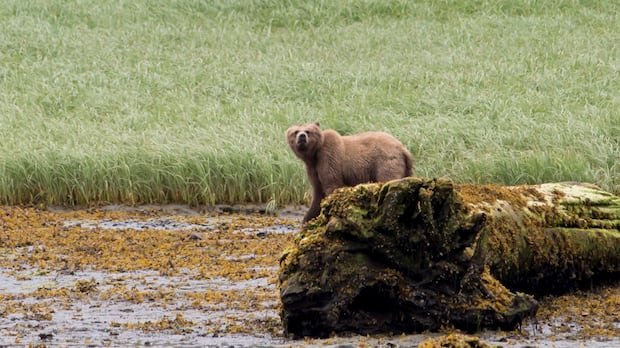
Efforts are underway to track down the bear responsible for the recent attack on a school group near Bella Coola, B.C. The aftermath of this incident remains uncertain.
Bear encounters are relatively common in Canada, particularly on British Columbia’s Central Coast. However, attacks involving large groups, like the one last week, are considered rare by conservation experts interviewed by CBC News.
There are currently around 13,000 grizzly bears residing in British Columbia, with many of them inhabiting the central coast region. The area near 4 Mile subdivision, on the traditional lands of the Nuxalk Nation where the attack transpired, boasts a significant bear population, estimated at about 22 bears per 1,000 square kilometers.
BC Conservation teams employ various methods to locate bears, including tracking their movements, strategically placing bait, and setting traps. Once a bear is captured and immobilized, officers compare the animal to witness descriptions and evidence gathered at the scene of the attack, such as tracks, hair, or items the bear may have interacted with during the incident.
Kevin Van Damme, an inspector with the B.C. Conservation Officer Service, mentioned that forensic evidence left by the bears on the victims’ clothing will also be analyzed to ensure accurate identification.
According to grizzly experts, the likelihood of a bear attack decreases as the size of a group increases. Brian Falconer of B.C.’s Raincoast Conservation Foundation noted that attacks on groups of more than six people are extremely rare, making the Bella Coola incident, involving at least 20 individuals, particularly unusual.
The motive behind the bear’s attack remains uncertain, with factors such as maternal protection or territorial disputes potentially playing a role in the bear’s behavior.
Following the identification of the bears involved, a team of experts, including wildlife veterinarians, large carnivore specialists, and wildlife biologists, will collaborate to determine the appropriate course of action. The Nuxalk Nation community, with its long history of coexisting with bears, may offer input on the best approach, which might not necessarily involve euthanizing the offending bear.
Decisions on relocating or euthanizing the bears will be made once they are positively identified and the circumstances surrounding the attack are clarified.
If relocation is deemed necessary, bears can be moved either locally to buy time for humans to eliminate attractants or translocated far away to prevent their return. However, relocation efforts are not always successful in preventing bears from returning to the original location.
The recent bear attack near Bella Coola has sparked discussions on the reinstatement of B.C.’s grizzly bear trophy hunt, which was halted in 2017. While some advocate for its revival, others argue that hunting hundreds of bears in response to a single incident is not a viable solution.
B.C. Environment Minister Tamara Davidson emphasized that the focus currently is on locating the bear responsible for the attack, as historical data suggests that hunting activities did not typically occur in areas prone to bear attacks.

