
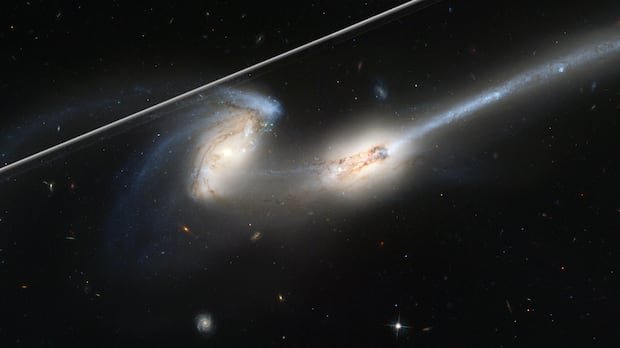
Satellite constellations, groups of satellites ranging from a few dozen to tens of thousands, are causing disruptions to scientific research conducted with ground-based telescopes. A recent study explores the potential impact of these constellations on space telescopes like the renowned Hubble Space Telescope.
The Hubble Space Telescope is renowned for capturing stunning images of galaxies and nebulas, as well as making significant scientific breakthroughs such as measuring the expansion rate of the universe. However, the proliferation of proposed satellite megaconstellations, including those planned by companies like SpaceX and Amazon, could pose a threat to the telescope’s operations.
Published in Nature, the study specifically analyzed the potential effects on Hubble, NASA’s SPHEREx, the European Space Agency’s proposed ARRAKIHS, and China’s planned Xuntian telescope. The findings indicate that if the projected 560,000 satellites are launched within the next decade, approximately 39.6% of Hubble’s images and 96% of the other three telescopes’ images would be impacted.
As these satellites traverse the sky, they leave long light streaks in telescope images and can disrupt radio astronomy by emitting electromagnetic radiation at low frequencies. The study estimates that, on average, Hubble would encounter 2.14 satellites per exposure, while SPHEREx, ARRAKIHS, and Xuntian would face higher numbers.
Lead author Alex Borlaff, a NASA research scientist, expressed concern over the increasing frequency of satellite sightings, highlighting the challenges they pose to astronomical research. The surge in satellites, primarily driven by companies like SpaceX and Amazon, aims to enhance global internet accessibility, leading to a crowded low Earth orbit.
Although ground-based observatories can adjust their research schedules to avoid satellite interference, space telescopes like Hubble may face more significant obstacles. The study underscores the growing issue of satellite constellations potentially hindering scientific observations and disrupting critical research efforts.
Furthermore, the study emphasizes the need to address the broader impacts of satellite constellations, including potential hazards to space-based astronomical observations and the cultural significance of preserving the night sky for future generations. The authors stress the importance of carefully considering the implications of satellite megaconstellations on both scientific exploration and our collective connection to the cosmos.

