
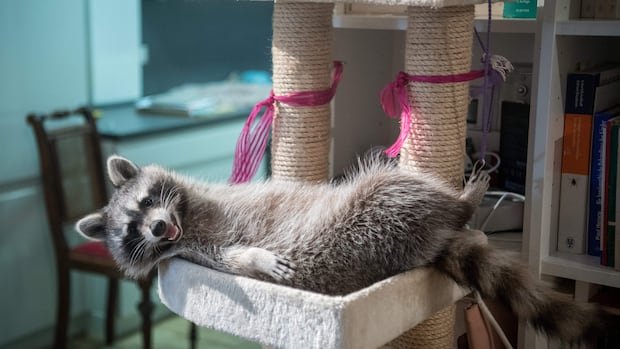
A recent study sheds light on the impact of city life on raccoons. While commonly associated with urban areas, raccoons are actually native to forests and woodlands, with a diet that includes corn, nuts, and berries. They are found in most Canadian provinces, except Newfoundland and Labrador.
Researchers from the University of Arkansas at Little Rock discovered that urban raccoons are adapting to city life by altering their diets and potentially undergoing domestication. This change is evident in physical traits, such as shorter snouts observed in raccoons living in densely populated urban areas.
Domestication is a gradual process where wild animals adapt to living closely with humans for various purposes. Urban raccoons are showing early signs of domestication, displaying traits like neoteny and increased tolerance towards humans.
Experts like Christina Sluka and Albrecht Schulte-Hostedde study how urban raccoons are evolving in response to human presence. They note that urban raccoons are already exhibiting traits associated with domestication syndrome. These changes may have significant implications for future raccoon populations in cities.
However, owning wild raccoons as pets is not recommended due to health risks associated with pathogens and parasites they may carry. While the domestication of raccoons is an intriguing phenomenon, it is still in its early stages and unlikely to lead to fully domesticated pet raccoons anytime soon. Urban raccoons may continue to evolve over time, potentially leading to distinct differences from their wild counterparts in the future.

