
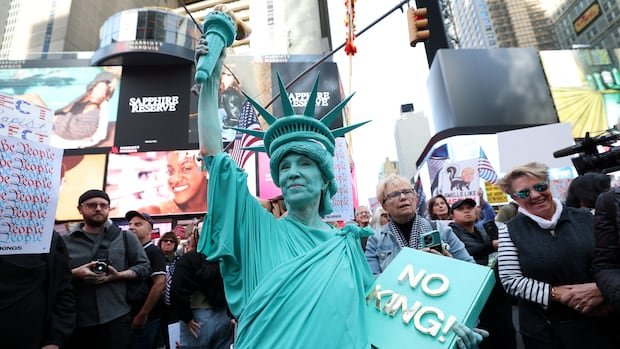
Thousands of individuals gathered across the U.S. on Saturday to protest against the current administration under President Donald Trump in what they termed “No Kings” demonstrations. The Republican Party has labeled these gatherings as “Hate America” rallies. This marks the third large-scale mobilization since Trump’s re-election, coinciding with a government shutdown that has disrupted federal programs and services, raising concerns about the power dynamics between the executive branch, Congress, and the judiciary.
Protesters voiced their dissatisfaction with the accusations made against them, emphasizing the patriotic nature of their dissent. Demonstrators in various locations, including Bethesda, Md., and Washington, D.C., expressed their commitment to the country while denouncing the administration’s policies and rhetoric. The protests, organized by a diverse coalition, aim to unify opposition against what they perceive as a slide towards authoritarianism.
While previous protests earlier this year targeted specific issues, such as government staff cuts and military displays, organizers believe the current demonstrations are fostering a broader opposition movement. Prominent Democratic figures, like Senate Minority Leader Chuck Schumer and Independent Sen. Bernie Sanders, are participating in the rallies, viewing them as a response to the administration’s actions, including restrictions on free speech and immigration policies.
In addition to nationwide protests, solidarity rallies were held globally, with support shown in cities like Montreal, Canada. Participants emphasized the importance of defending democracy and national sovereignty while standing against divisive rhetoric from the U.S. administration. The demonstrations in major cities abroad also featured American expatriates expressing their concerns and waving flags in solidarity.
Republicans have criticized the rallies as being extreme and disruptive, linking them to the ongoing government shutdown. Party leaders have characterized participants as radicals and blamed Democratic officials for aligning with leftist groups. In contrast, Democratic leaders have refrained from voting on funding bills until healthcare issues are addressed, signaling a firm stance against Trump’s policies and a push for a return to a balanced governance structure.
The current political climate reflects a shift in Democratic strategy compared to earlier this year, with increased unity and assertiveness in challenging the administration. Organizers and supporters believe that maintaining pressure and resistance is crucial to safeguarding democratic principles and preventing authoritarian tendencies from taking root.

