
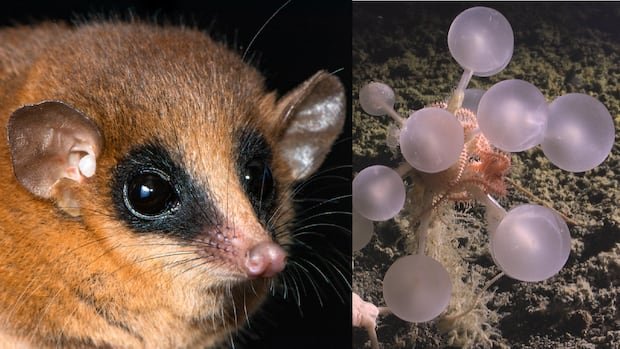
In 2025, scientists have described a variety of fascinating new species, including a tarantula with exceptionally long male genitalia, a caterpillar that adorns itself with its prey’s body parts, and a small opossum residing in mountainous regions. Research indicates that approximately 16,000 novel species are unearthed annually, with a notable acceleration in discovery rates – 15% of all known species have been newly documented within the last two decades.
Many of these discoveries were not entirely novel, as some had been locally observed, photographed, or collected for museums in previous years but had not been formally classified by the scientific community until now. Nonetheless, the process of official identification is crucial, as it plays a vital role in species preservation efforts. According to John Wiens, an ecology professor at the University of Arizona, “We can’t safeguard a species from extinction if we don’t know it exists.”
Among the remarkable findings are four new tarantula species from the Horn of Africa and the Arabian Peninsula, with males possessing notably elongated genitalia. The largest species, known as Satyrex ferox, boasts a leg-span akin to the width of a slice of bread, while its male members possess palps measuring up to five centimeters, nearly as long as their legs. These elongated palps may serve a defensive purpose during mating to prevent male attacks by aggressive females.
In Hawaii, scientists uncovered a unique caterpillar known as the “bone collector,” which inhabits spider webs, preys on trapped insects, and fashions a coat of body parts around itself before metamorphosis. This distinctive caterpillar, highlighted in a study published in Science, is confined to a small forest area in the Wai’anae mountain range on O’ahu, indicating a potential endangered status.
Exploration in the deep Southern Ocean near Antarctica led to the discovery of 30 new species, including the carnivorous “death-ball” sponge, characterized by spheres covered in tiny hooks for prey capture. Additionally, new sea star species and an iridescent scale worm were identified during the expedition.
In shallower waters, a sea slug named Phyllidia ovata, resembling fried eggs, was unveiled in Indonesia, preying on sponges and storing their toxins for defense. This visually striking species, previously sighted by divers but officially described in July, employs bright colors as a warning signal to potential predators.
Furthermore, a new species of crayfish, the Okanagan crayfish, was identified in British Columbia’s Okanagan Lake, distinct from its lookalike, the signal crayfish, due to the absence of a characteristic white mark on its claw. The species is believed to be endangered, raising concerns due to heavy human activity in the lake.
Canadian researchers contributed to the discovery of six tube-nosed bat species from the Philippines, each weighing between four to 14 grams. These bats, collected over the past three decades, were described in a study co-authored by Judith Eger and Burton Lim of the Royal Ontario Museum.
Lastly, a small mouse opossum species, Marmosa chachapoya, was documented in the Peruvian Andes, residing at higher elevations than its counterparts. This mouse-sized marsupial, described in the American Museum Novitiates, offers a glimpse into the diverse fauna of the region.

