
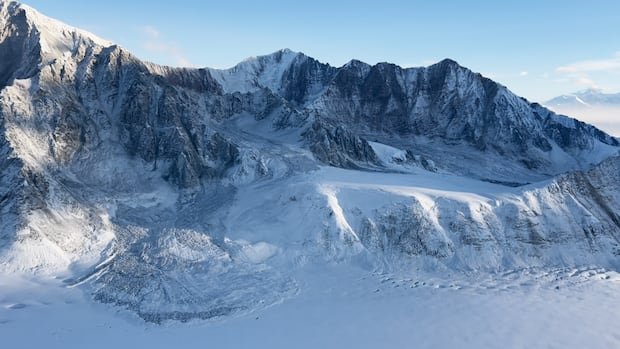
A team of researchers from the Yukon Geological Survey is using a helicopter to explore a remote mountain area in southwest Yukon, searching for avalanches and landslides following a magnitude 7.0 earthquake that occurred last month near the Alaska-Yukon border. This seismic event has helped validate a long-standing theory by revealing a previously unknown fault beneath the Earth’s surface.
The region has been relatively unexplored, particularly by experts like Michael West, Alaska’s state seismologist and research professor at the Alaska Earthquake Center. West highlighted the uniqueness of the southwestern Yukon area, where two major plate boundary systems intersect at nearly a right angle, leading to a complex geological setup often referred to as the ‘train wreck of plate tectonics.’
While both Alaska and the Yukon are known for their seismic activity, the recent earthquake hit a specific area with historically low earthquake occurrences. This anomaly has long fueled speculation about a connection between the North American plate boundary and significant faults within the plate’s interior.
The earthquake, which struck on Dec. 6 at 12:41 p.m. local time, was most strongly felt in communities like Burwash Landing and Haines Junction, Yukon, with tremors reaching as far as Whitehorse, approximately 250 kilometers away. Residents, like Pascale Dubois from Burwash Landing, recounted the intense shaking and fear of structural collapse during the event.
Despite the earthquake’s size, its impact on Yukon residents was relatively minor, emphasizing the region’s resilience. Geologists, including Jan Dettmer from the Yukon Geological Survey, see the earthquake aftermath as a valuable opportunity to study the deformation processes in the area and gain insights into mountain-building activities.
Ongoing research efforts aim to map the newly discovered fault lines to enhance understanding of seismic risks in the region and potentially provide valuable insights for neighboring communities. The international scientific community is closely monitoring these developments, expecting new discoveries and possibly the identification of previously unknown fault systems.

