
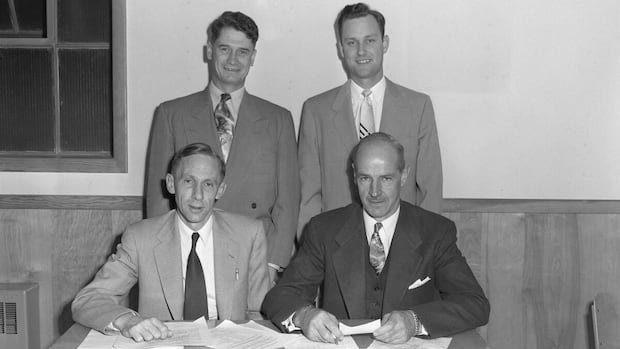
Voters casting their ballots on October 20 in Calgary and Edmonton will encounter municipal candidates affiliated with political parties. This occurrence is relatively new for most voters, although historical data reveals the presence of political parties at the local level in Alberta dating back to the late 1910s to the 1950s. According to local historian Harry Sanders, party politics in a formal capacity, involving endorsements and campaign activities for local parties, have been part of Calgary since around the First World War era.
In the early 1900s, Calgary’s council consisted of 12 aldermen representing four wards, with the Dominion Labor Party emerging as the primary municipal party post-World War I. This party, a local branch of the provincial group, gained prominence by securing a majority in Calgary city council. Subsequently, the Civic Government Association (CGA) arose in 1922 to counter the Dominion Labor Party’s influence and remained dominant until the 1950s.
Unlike the strict party discipline seen at higher levels of government today, historical municipal parties allowed councillors considerable freedom in their voting decisions. Despite this, voters gravitated towards party affiliations during the reign of the Dominion Labor Party and the CGA.
Over time, the influence of municipal parties waned, leading to the emergence of new organizations like the United Citizens’ Association (UCA) in the mid-20th century. By the late 1970s, the participation of parties in local politics decreased significantly due to shifting policy responsibilities and the transition to a ward system in Calgary.
In 2024, a new legislation was introduced allowing the presence of local political parties on city council ballots in Calgary and Edmonton. Presently, Calgary features three parties on the ballot, while Edmonton has two. The impact of these parties on local governance and democracy remains uncertain, with questions arising on the post-election coordination and long-term implications of party participation.

