
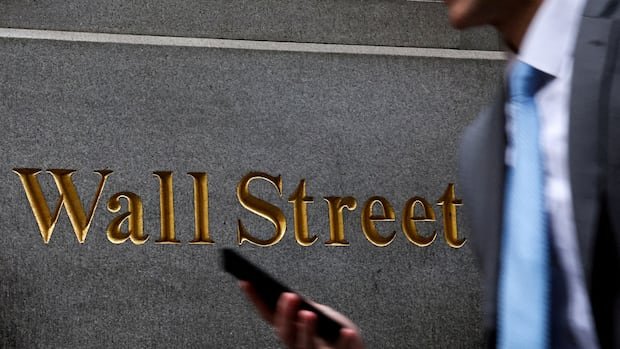
Stocks took a plunge on Wall Street during afternoon trading on Tuesday following U.S. President Donald Trump’s threat to impose new tariffs on eight NATO members amid escalating tensions over his efforts to assert American authority over Greenland. The S&P 500 experienced a significant decline of 2.1% on Tuesday, marking its largest drop since October. This drop came as U.S. markets reopened after being closed on Monday for Martin Luther King Jr. Day.
The Dow Jones Industrial Average also fell by 877 points, equivalent to a 1.8% decrease, as of 2:46 p.m. ET, while the Nasdaq composite witnessed a 2.4% slump. Both European and Asian markets saw declines as well. In Canada, the main stock index, the S&P/TSX composite, dropped by 340.68 points to 32,750.28.
The market downturn on Wall Street was widespread, led by technology stocks, which carry significant influence due to their high values. Retailers, banks, and industrial companies also experienced sharp declines. Notable companies like Nvidia, Amazon, JPMorgan Chase, and Caterpillar saw respective drops in their stock values.
Amidst the market turmoil, consumer staple companies such as Colgate-Palmolive and Campbell’s managed to maintain better positions compared to others. On the commodities front, the price of U.S. crude oil rose by 1.5% to $60.34 US per barrel, while Brent crude, the global standard, increased by 1.3% to $64.76 US.
Trump’s announcement of imposing a 10% import tax on goods from Denmark, Norway, Sweden, France, Germany, the United Kingdom, the Netherlands, and Finland in February stirred the markets further. This decision affected European markets and led to higher Treasury yields in the bond market. The collective annual imports from European Union nations surpass those from the top two individual importers into the U.S., Mexico, and China.
Before U.S. markets opened, major European markets in Paris, Frankfurt, and London experienced drops exceeding one percent and were on course for a second consecutive day of losses. Amid the escalating tensions, the prices of silver and gold surged as investors sought safe-haven assets. Gold saw a 3.7% increase, while silver soared by 6.9%.
The trade tensions impacted the recent rally in bitcoin, causing the cryptocurrency to retreat from its peak above $96,000 US to around $89,300. In the bond market, Treasury yields showed mixed movements, with the 10-year Treasury yield rising to 4.29% and the two-year Treasury yield slipping to 3.59%.
Trump’s assertive stance regarding Greenland, linked to last year’s Nobel Peace Prize decision, has heightened tensions with U.S. allies. His communication with Norway’s Prime Minister Jonas Gahr Støre signaled a deepening standoff over Greenland’s status as a self-governing territory of NATO member Denmark.
Across Europe, Trump’s tariff threats sparked outrage and triggered diplomatic responses, including discussions on potential countermeasures and the utilization of the European Union’s anti-coercion instrument. The escalating trade and political conflict with Europe coincides with world leaders gathering at the World Economic Forum annual meeting in Davos, Switzerland.
Analysts like Dan Ives from Wedbush Securities expressed concerns over the impact of the new tariff threats on the ongoing conference but remain optimistic that tensions will ease over time through negotiations. The uncertainty surrounding tariffs has been a prevailing issue since 2024, complicating economic planning for businesses amidst rising inflation and global economic volatility.

