
In the midst of uncertainty surrounding Donald Trump’s recent social media announcement regarding a 10% tariff increase on Canadian goods, Canadian officials are seeking clarification while the U.S. president himself lacks specific details. Despite Trump’s online declaration of the tariff hike, the targeted Canadian exports and the official notice to Canada regarding this action remain undisclosed.
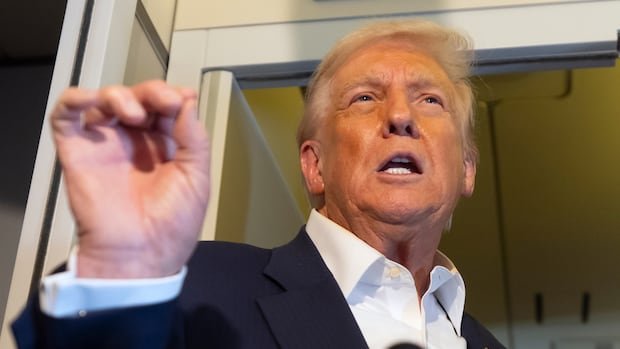
During a press interaction aboard Air Force One, Trump avoided discussing the timeline for implementing the tariff increase, stating, “I don’t know when it’s going to kick in, and we’ll see, but I don’t really want to discuss it.” Trump, however, elaborated on the Ontario government advertisement that seemingly led to the cancellation of trade negotiations with Canada and the subsequent tariff announcement.
Trump’s claims regarding the Ontario ad, which featured excerpts from Ronald Reagan’s radio address on free trade, were disputed, with evidence suggesting Reagan was staunchly against tariffs on economic allies like Canada. Trump alleged that the ad misrepresented Reagan’s stance on tariffs, attributing it to catering to the Supreme Court.
The U.S. Supreme Court is scheduled to hear arguments on November 5 concerning the Trump administration’s appeal against a ruling that challenged the president’s authority to impose broad tariffs on Canada, Mexico, and other countries over issues like fentanyl trafficking, illegal immigration, and trade imbalances.
Trump defended his decision to halt trade talks with Canada, citing the Ontario government’s ad as a significant factor. He expressed discontent with Canada’s trade practices, referencing a long history of what he perceived as unfair dealings. Despite his reluctance to meet with Prime Minister Mark Carney at an upcoming summit, Trump conveyed satisfaction with the existing trade agreement with Canada without specifying further details.
The White House indicated that the Ontario ad was not the sole reason for Trump’s aggressive trade actions against Canada. Senior officials were engaged in discussions with Canadian counterparts regarding potential tariff relief on steel and aluminum imports before negotiations were abruptly terminated by Trump.
Public statements from the White House criticized Canadian officials for allegedly prioritizing games over engaging with the U.S. administration. The decision to cancel negotiations reflected Trump’s frustration with the Canadian stance during months of talks, as highlighted by Kevin Hassett, director of the National Economic Council.
Treasury Secretary Scott Bessent condemned the Ontario ad as meddling in U.S. affairs and labeled it as propaganda aimed at undermining tariffs. When questioned about the specifics of the tariff increase on Canadian goods, Bessent avoided direct responses, mirroring the administration’s guarded approach to disclosing details.

