
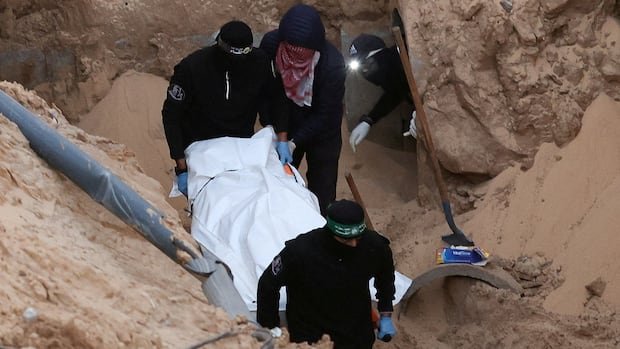
Israel stated on Saturday that the three bodies delivered by Hamas to the Red Cross in Gaza were not those of hostages, further complicating the U.S.-brokered ceasefire in the Israel-Hamas conflict. The exchange followed Israel’s return of 30 Palestinian bodies to Gaza, completing a swap after militants previously handed over two hostages’ remains.
Israeli Prime Minister Benjamin Netanyahu’s office confirmed that the three bodies were not hostages, leaving uncertainty about their identities. Hamas’ armed wing claimed it had offered samples of unidentified bodies on Friday, but Israel declined and requested the remains for examination to verify.
The handover was intended to halt Israel’s assertions, according to Hamas. Health authorities in Gaza have struggled to identify bodies due to the absence of DNA kits.
In Tel Aviv, families and supporters gathered once more on Saturday night, demanding the return of all hostages. Since the ceasefire began on Oct. 10, Palestinian militants have released the remains of 17 hostages, with 11 still in Gaza. The process has been slow, with one or two bodies released every few days, prompting Israel to urge swifter progress. Hamas cited challenges due to extensive destruction and Israeli military presence in certain areas.
Israel has returned 225 unidentified Palestinian bodies in exchange for each Israeli hostage’s remains. Only 75 have been identified by families, as reported by Gaza’s Health Ministry. Uncertainty remains about the circumstances of the bodies, whether they were from the 2023 Hamas-led attack on southern Israel that triggered the conflict, detainees who died in Israeli custody, or casualties recovered from Gaza during the war.
The ceasefire faced a major test when Israel conducted airstrikes across Gaza earlier in the week, resulting in over 100 casualties following the killing of an Israeli soldier in Rafah.
Jordan’s foreign minister cautioned on Saturday that Israel’s military presence in Gaza jeopardizes the ceasefire. At a security summit, Ayman Safadi stressed the need for Palestinian security forces backed by an international stabilization force with a UN mandate to maintain security in Gaza.
The U.S. peace plan proposes a temporary international stabilization force involving Arab partners to secure Gaza’s borders and ensure ceasefire compliance. General Dan Caine, visiting chairman of the Joint Chiefs of Staff, met with Israeli officials to discuss the plan. Several countries have expressed interest in contributing to a peacekeeping force but insist on a clear UN mandate before deploying troops.
Challenges include Hamas disarmament, postwar governance in Gaza, and the timing and method of increasing humanitarian aid. Indonesia has offered thousands of troops for Gaza, emphasizing the importance of a UN mandate for deployment.
Indonesian officials have advocated for an independent Palestinian state while emphasizing the need to ensure Israel’s safety and security. The conflict, originating from the 2023 Hamas-led attack, resulted in significant casualties and hostage-taking.
Israel’s military actions in Gaza have reportedly led to over 68,600 Palestinian deaths, as per Gaza’s Health Ministry. Israel has rejected allegations of genocide in Gaza but has not provided a conflicting death toll.

