
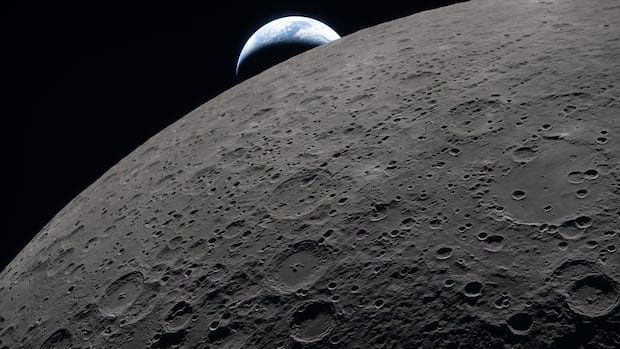
The Artemis II team is on their way back to Earth after witnessing a unique sight of the moon. Canadian Space Agency astronaut Jeremy Hansen, along with NASA astronauts Reid Wiseman, Victor Glover, and Christina Koch, achieved a significant milestone by venturing farther from Earth than any previous humans during the Artemis II mission.
While satellites have captured images of the moon’s far side since 1959, the Artemis II mission allowed humans to directly observe some far-side regions for the first time. NASA’s Artemis II lunar science lead, Kelsey Young, expressed excitement about the opportunity for humans to visually inspect and describe lunar features firsthand.
During a media conference, Young highlighted the capability of the human eye, especially when combined with a well-trained brain, to make detailed color observations rapidly. The crew spent five hours making observations using both cameras and their naked eyes, providing intricate descriptions of what they saw.
Of particular interest was the Orientale basin, believed to have formed around 3.8 billion years ago. Hansen noted color variations extending towards the Hertzsprung crater on the moon’s far side, describing brownish and greenish hues in the region.
While it may seem unusual, the moon does exhibit colors that can be seen by increasing saturation in photographs, originating from different minerals on its surface. However, the human eye surpasses the capabilities of a camera in distinguishing subtle differences without the need for saturation adjustments.
Ralph Chou, a professor emeritus at the University of Waterloo, emphasized the visual system’s superiority in detecting color and brightness variations compared to electronic systems. Moreover, humans benefit from real-time, 3D observations of lunar features.
During the lunar flyby, the crew also witnessed meteoroids impacting the moon’s surface, a phenomenon rarely observed on Earth due to the absence of a substantial atmosphere on the moon. Victor Glover reported seeing impact flashes, providing valuable firsthand insights that cameras may not capture.
The ability of humans to witness transient events like impact flashes underscores the importance of combining visual observations with camera data for a comprehensive understanding of lunar phenomena. NASA’s chief exploration scientist, Jacob Bleacher, praised the crew’s descriptions of the moon’s features, highlighting the scientific value of their observations.
In conclusion, the Artemis II mission not only marked a historic milestone in human space exploration but also demonstrated the unique insights that direct human observation can provide in studying celestial bodies like the moon.

