
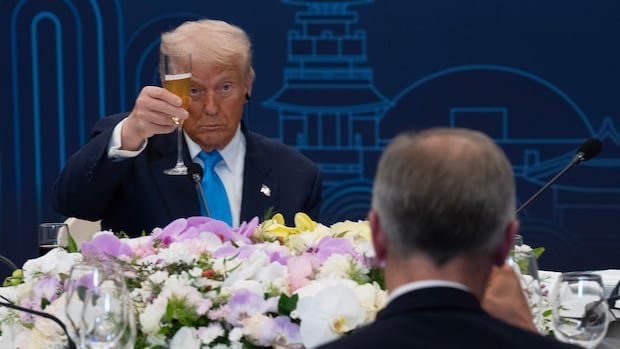
U.S. President Donald Trump and Prime Minister Mark Carney sat facing each other and exchanged pleasantries during a dinner preceding the Asia-Pacific Economic Co-Operation Summit on Wednesday. However, their interaction revealed a noticeable lack of dialogue, underscoring the strained relationship between the U.S. and Canada.
This marked the first in-person meeting between the two leaders since Trump called off trade discussions in response to an anti-tariff advertisement by the Ontario government. When questioned by a Global News journalist after the dinner, Carney mentioned having “very good conversations with all the presidents” present.
Upon arriving in South Korea, Carney was confronted with the proximity of Air Force One to his aircraft, symbolizing the challenges Canada faces heading into the APEC meeting. One of these challenges includes repairing the country’s ties with China amidst the escalating tensions with the U.S.
As Canada navigates the delicate balance between the deteriorating relationship with Trump and the need to engage with China, Carney aims to diversify trade partnerships. However, any potential concessions to enhance ties with China, such as revisiting electric vehicle tariffs, are likely to encounter resistance from Washington.
Ahead of the APEC summit, Trump seems inclined to make trade concessions with China, raising questions about Carney’s flexibility in pursuing similar agreements. Reports suggest that the U.S. could reduce tariffs on Chinese goods in exchange for stricter controls on fentanyl precursor chemicals.
Experts caution against reading too much into pre-summit speculations, noting the unpredictability of U.S. trade policies. Carney’s upcoming meeting with Xi Jinping presents a delicate balancing act, as he must navigate the complex dynamics between the U.S., China, and Canada’s trade interests.
Carney’s interactions with Xi will be closely watched not only by the U.S. but also by other regional allies, who seek clarity on Canada’s commitment to diversifying trade. As Carney seeks to strengthen ties with China, concerns linger about the broader implications on trade and security relationships in the Indo-Pacific region.
While Carney leverages his business connections in the region, the U.S. and China are actively pursuing trade agreements to bolster their presence in Asia. Trump recently secured deals with various countries to reduce reliance on China’s rare earth minerals supply, while China announced an expanded free trade agreement with 11 nations shortly after the ASEAN meeting.
Carney’s visit to South Korea underscores Canada’s commitment to the Asia-Pacific region, signaling the importance of fostering partnerships amid global uncertainties. As geopolitical tensions persist, regional allies like Korea view Canada as a reliable partner in navigating the evolving economic landscape.

