
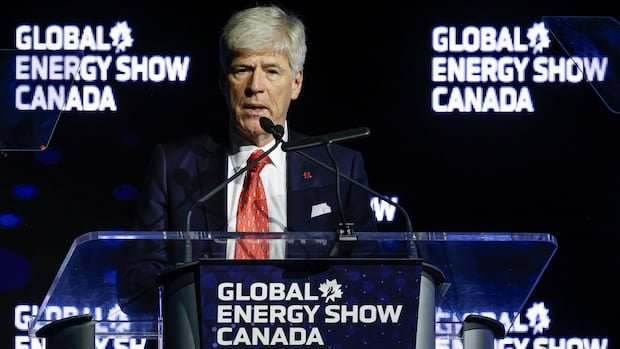
Federal Minister of Natural Resources, Tim Hodgson, delivered a message to international delegates at the Global Energy Show in Calgary, emphasizing Canada’s potential as a reliable energy supplier amidst global volatility. However, doubts were raised by the CEO of a major oilsands producer regarding Canada’s commitment to supporting a new West Coast oilsands pipeline, which is tied to a multibillion-dollar emissions-reducing project and industry carbon levy.
Hodgson highlighted Canada’s reliability, democracy, and renewed business-friendly environment during the conference, coinciding with global energy market disturbances due to ongoing tensions in the Middle East. The event was anticipated to draw 30,000 attendees, with a greater international presence compared to previous years.
Emphasizing the interconnectedness of energy policy with economic, security, trade, and investment policies, Hodgson stressed that Canada is actively responding to current challenges rather than waiting for opportunities to materialize.
Last year, Alberta Premier Danielle Smith advocated for a new bitumen pipeline to the northwest coast, with plans for the Alberta government to submit an application by July 1 to the federal major projects office. However, the pipeline lacks private-sector backing at present.
An energy accord signed between Alberta and Ottawa last year outlines the prerequisites for a new West Coast oil pipeline, hinging on the progress of the Pathways carbon storage project. Cenovus Energy Inc.’s CEO, Jon McKenzie, expressed optimism about the increased collaboration between federal and provincial governments but highlighted concerns among oilsands producers regarding the associated carbon pricing policies.
The Pathways project aims to reduce carbon dioxide emissions by 16 megatonnes by 2045, with Cenovus and other oilsands companies leading efforts to transport captured CO2 to a storage hub near Cold Lake, Alberta. McKenzie raised questions about the financial viability and benefits of the project, estimating costs of $20-30 billion while yielding minimal global emission reductions.
Regarding the proposed pipeline, McKenzie underscored the challenges of securing private sector financing under current conditions, emphasizing the need for a competitive investment environment to incentivize industry participation in major projects like the West Coast pipeline.
The Alberta government targets the pipeline’s designation as a project of national interest by October, aiming to commence construction as early as September 2027. Premier Smith acknowledged the execution challenges but expressed confidence in meeting targets outlined in the agreement, signaling a commitment to attracting investment by demonstrating progress towards project milestones.

