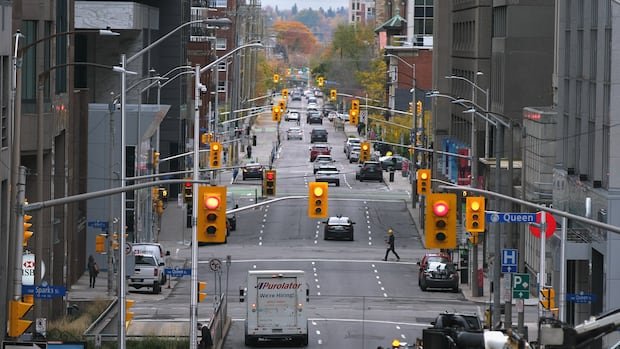

Drivers face a critical moment when the traffic light transitions from green to yellow, requiring quick decision-making based on various factors such as distance, time, speed, and surrounding traffic conditions.
The duration of yellow lights, even those that appear brief, is meticulously calculated by traffic engineers who consider a range of scientific principles and driver behaviors at intersections.
Jodie Marcyniuk, overseeing traffic management at the city of Calgary, explains that the timing of amber lights and the subsequent “all red” period are determined based on fundamental physics concepts like vehicle speed, deceleration rates, road slope, and driver reaction times.

Every intersection is assessed as a unique case, considering factors like topography and speed limits to determine the appropriate duration of yellow lights.
Stopping on yellow: A Safety Principle
Marcyniuk advises that when it is safe to stop at a yellow light, drivers should do so instead of attempting to rush through the intersection. Safety should always be prioritized over saving a few seconds.
Travis Stocking, a senior traffic analyst in Whitby, Ont., highlights the importance of optimizing traffic light timings to facilitate smoother traffic flow, aiming to create efficient “platoons” of vehicles moving through intersections.
However, Stocking acknowledges the unpredictability of real-world traffic dynamics, where ideal scenarios on paper may not always translate into seamless traffic operations.
Considerations for Traffic Signal Design
Engineers must strike a balance in signal timings to avoid unintended consequences, such as prolonged amber signals leading to risky driver behavior and potential rear-end collisions.
Instances like Ron Usher’s, who received a red-light camera ticket in Vancouver due to tailgating circumstances, underscore the complexities of driver decision-making at intersections.