
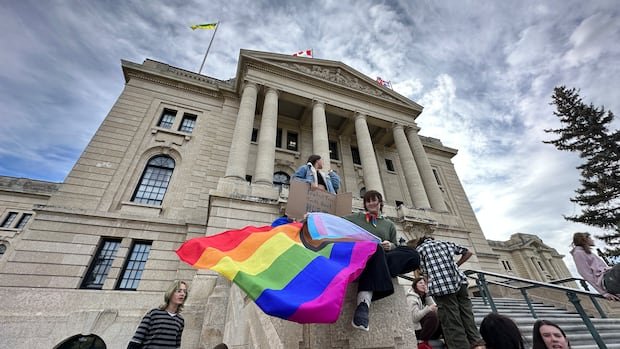
The president of the Saskatchewan Teachers’ Federation expressed optimism that the Supreme Court will provide clarity on the province’s pronoun law as the highest court in Canada has agreed to hear appeals on the matter. The law, which requires parental consent for children under 16 to change their names or pronouns at school, has created challenges for teachers, according to Samantha Becotte.
Becotte emphasized the need for the government of Saskatchewan to repeal Bill 137 to grant teachers professional autonomy in creating safe learning environments for all students in Saskatchewan. The date for the court to hear appeals from the provincial government and UR Pride, a 2SLGBTQ+ group in Regina, has not been scheduled.
Introduced as a policy by Premier Scott Moe’s Saskatchewan Party government in 2023, the law has faced legal challenges from UR Pride, citing violations of Charter rights and harm to gender diverse youth. Despite a granted injunction to halt the policy, the province enacted it into law a month later using the notwithstanding clause to override certain Charter rights for five years.
Saskatchewan’s Court of Appeal ruled that the challenge against the law can proceed, stating that while the legislation cannot be struck down due to the notwithstanding clause, a declaratory judgment can be issued on its constitutionality. UR Pride retains the ability to argue for the law’s nullification based on the exclusion of the notwithstanding clause from Section 12 of the Charter.
Both UR Pride and the province have appealed to the Supreme Court to expedite the case alongside a challenge to a Quebec law regarding religious symbols in the public sector, which also invoked the notwithstanding clause in its implementation.
Adam Goldenberg, representing UR Pride, highlighted the violation of Charter rights and harm to gender diverse youth by the law, emphasizing the importance of the government defending the law with evidence in court. Louis-Philippe Lampron, a constitutional law professor at Université Laval in Quebec, noted the significance of the Supreme Court hearing the case in the context of evolving Canadian law and the implications of populist sentiment influencing provincial legislation.
In Alberta, a similar legal battle is unfolding, with Premier Danielle Smith’s government invoking the notwithstanding clause to address a provincewide teachers’ strike and protect legislation related to school pronouns, female sports, and gender-affirming health care. The government’s plans to use the notwithstanding clause in these laws, which have faced challenges, have sparked debate over the balance between legislative power and judicial oversight.

