
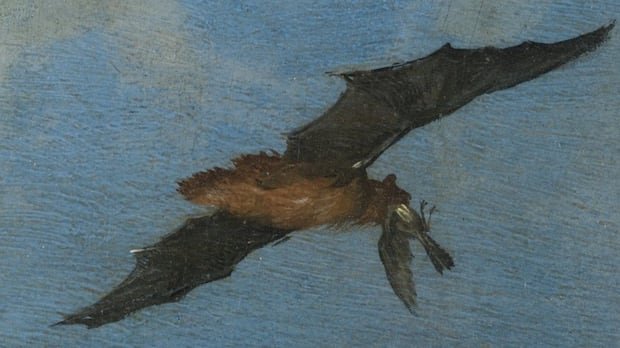
Europe’s largest bat has been found to possess a remarkable ability: capturing and consuming birds while in flight. This behavior, which scientists confirmed last year, has now been further supported by ecologists who discovered evidence of this feeding habit hidden in a painting by 17th-century Flemish artist Jan Brueghel the Elder.
In a study published in the journal Proceedings of the National Academy of Sciences, researchers identified a large noctule bat depicted in Brueghel’s painting titled “Air,” with what appears to be a bird held in its jaws. Ecologist Miguel Clavero, one of the study’s co-authors, initially noticed this detail while cataloging animals in the artwork and sought confirmation from bat experts.
The investigation into the bats’ bird-catching behavior dates back to 2001 when researchers found bird feathers in bat feces, indicating a preference for larger prey. Recent confirmation of this behavior involved equipping greater noctule bats with tracking devices to monitor their activities.
While some experts speculate that Brueghel may have based his painting on real natural history knowledge, others suggest it could be a symbolic addition typical of his artistic style. Despite differing opinions, the discovery underscores the potential for uncovering valuable insights about wildlife through historical art.
This revelation not only sheds light on historical biodiversity but also prompts a reevaluation of what may have been lost over time. Researchers believe that further exploration of paintings, manuscripts, and other historical records could reveal additional hidden aspects of natural history waiting to be unveiled.

