
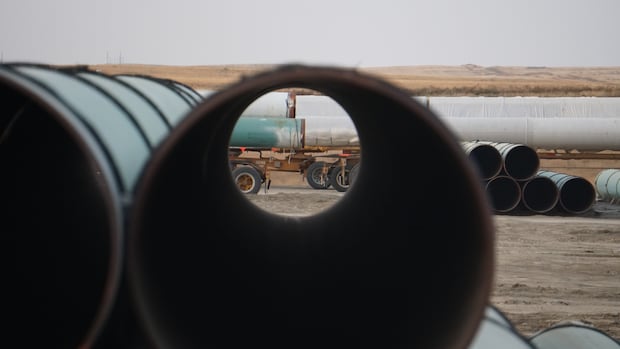
U.S. President Donald Trump has stated that a Canada-U.S. oil pipeline project, which was halted by two previous administrations, “might be brought back to life” as part of a new trade agreement between the two countries.
Yet, a former executive associated with Keystone XL, along with various industry analysts, indicate that this comment could be more politically motivated than about oil.
In a social media update late Tuesday, just under two hours before new tariffs on Canadian imports were set to take effect, Trump announced a “deal” with Canada and a temporary pause on the tariffs for three days.
“The great Keystone XL Pipeline, long ago killed by Sleepy Joe Biden, may be awoken from the grave!” he declared in a post on his Truth Social platform, referring to the former president.
Prime Minister Mark Carney did not comment on this during his response to Trump’s statement.
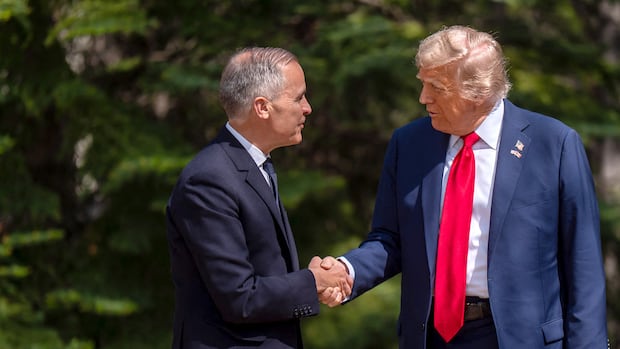
U.S. President Donald Trump has paused 50 percent tariffs on Canada, saying the two countries have reached a new trade deal that just needs to be finalized. In a statement, Prime Minister Mark Carney said ‘substantial progress has been made.’
For U.S., Keystone XL ‘can be a nightmare’
“The fact that Trump has indicated this is something he envisions in the agreement is beneficial for Carney [and] the compromises he will have to navigate in the coming 72 hours,” Dennis McConaghy, former executive vice-president of corporate development at TransCanada Corporation, now known as TC Energy, remarked.
Since February 1, 2025, the Republican president has imposed tariffs on vital sectors of Canada’s economy, affecting goods such as auto parts, lumber, steel, and aluminum, when his administration announced extensive tariffs on Canadian imports.
He has consistently claimed that the U.S. does not require anything from Canada, even while crucial commodities like oil, potash, and essential minerals remain exempt from U.S. tariffs.
“Given a person who claims we don’t need anything from Canada, that [Keystone XL comment] was somewhat encouraging,” McConaghy noted.
Nevertheless, Carlo Dade, director of international policy at the University of Calgary’s School of Public Policy, informed CBC Radio’s Calgary Eyeopener that reviving the contentious project would encounter the same political and environmental hurdles that have historically plagued it.
“Let’s not get overly enthusiastic about Keystone just yet,” Dade warned on Wednesday.
“Will it be finalized by the end of his term? Because we might have Democrats in the next election, which would complicate matters significantly,” he cautioned. “He perceives this as a repudiation of the policies of prior administrations, particularly Biden’s.”
Valérie Beaudoin, a member of the federal government’s Advisory Committee on Canada-U.S. Economic Relations, stated that approving Keystone XL would be considerably simpler for Carney than for Trump.
“For them, it can be a nightmare,” she remarked. “Even if Trump claims, ‘Oh, Keystone XL is back on track,’ who will be interested in investing when we know that in 2028, the next president could be a Democrat?”
“It’s all definitely intended as a response to Biden,” said Commodity Context founder Rory Johnston in an email to CBC News. “[It] would be entirely unexpected, and make little immediate sense to literally bring back KXL given the advancements made on other projects up to now. [It’s] also a much different market than when KXL was first proposed.”
Ottawa revives interest in Keystone XL
Approximately 85 to 90 percent of Canada’s crude oil exports are shipped directly to the U.S., a slight decrease since the 2024 expansion of the Trans Mountain pipeline, which transports oil to Asian and other non-U.S. markets from terminals located on the West Coast.
The Keystone Pipeline System, which is 4,327 kilometers long and owned and operated by Calgary-based South Bow Corp., delivers Canadian and U.S. crude oil to refining markets in Illinois, Oklahoma, and Texas.
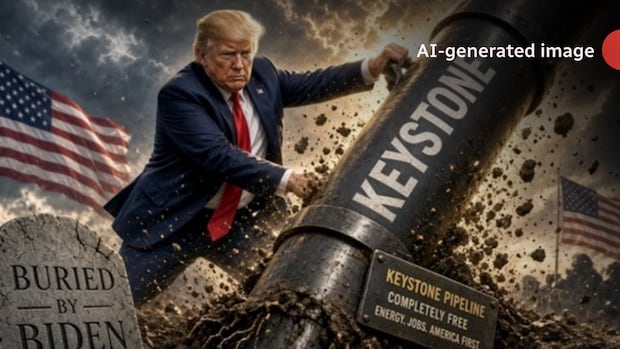
In a late-night post on his Truth Social account, U.S. President Donald Trump hinted at a possible rebirth of the cancelled Keystone XL pipeline. The post included an AI-generated image of Trump pulling the pipeline out of a grave.
South Bow did not respond to a request for comment on Wednesday.
In 2008, TransCanada and ConocoPhillips, the original owners of Keystone, proposed an extensive extension to the network known as Keystone XL. Following years of political, legal, and environmental opposition, which included cancellations by the Obama and Biden administrations, the project was effectively abandoned by its proponents.
Upon returning to the White House in 2025, Trump overturned Biden’s termination order and authorized the revival of parts of the project in the U.S. He has since expressed support for the project’s advantages on numerous occasions.
Last fall, CBC News reported that Carney discussed the project with Trump, indicating his renewed interest in moving forward with Keystone XL. The project still has full permits from the Canadian government, and by 2021, approximately 150 kilometers of pipeline had been installed in Alberta.
Prairie Connector project
South Bow was formed in 2024 when TC Energy divested its oil pipeline division to focus on natural gas. The company is currently collaborating with Wyoming-based Bridger Pipeline on a venture called Prairie Connector, utilizing sections of the previously constructed Keystone XL pipeline on the Canadian side of the border.
If realized, the Prairie Connector project could enhance Canada’s crude oil exports to the U.S. by over 12 percent.
“Should this project come to fruition, it would add significant value,” McConaghy, a former TransCanada executive, stated.
Bevin Wirzba, CEO of South Bow, has highlighted the strong long-term demand in the U.S. for Canadian crude, referencing the company’s recent open-season process for Prairie Connector.
The company claims that this process resulted in 20-year binding commitments from nine clients, amounting to 465,000 barrels of oil per day of guaranteed transportation service from Hardisty, Alberta, to South Bow’s U.S. delivery locations.
South Bow has yet to finalize its investment decision for the project.
“Disruptions in global crude oil trade have led to increased demand for connections to refining and export markets,” Wirzba explained to stock market analysts during a post-earnings conference call on August 5.
“And we have consistently maintained that the demand in the Gulf Coast for Canadian crude in that refining market has been and will continue to be robust for decades ahead.”

