
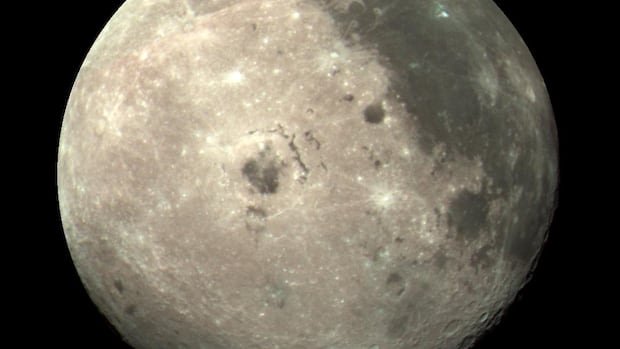
When Jeremy Hansen, a Canadian astronaut, embarks on the Artemis 2 mission, he will have the unique task of observing the far side of the moon, an area invisible from Earth. Simultaneously, scientists on Earth plan to deploy telescopes and robots to explore this region further.
The moon presents two distinct faces due to its gravitational lock with Earth, always showing one side to us and the other side to deep space. Contrary to popular belief, the far side, often called the dark side, receives as much sunlight as the near side. It features a rugged, crater-dense terrain unlike the smooth, flat plains known as “Maria” on the near side.
The far side of the moon offers a quiet environment shielded from Earth’s artificial radio interference, making it an attractive spot for astronomers to position radio telescopes. Astronaut Hansen will have a rare opportunity to witness sights unseen by many since the Apollo era, as the Artemis mission will take him 7,500 kilometers beyond the moon’s surface, providing a unique global perspective.
During the flyby of the moon, the Artemis crew will closely observe the lunar surface through the spacecraft windows. The human eye can discern subtle details that cameras might miss, such as variations in color and shades of grey indicating different ground conditions essential for future spacecraft landings.
Proposed missions to the far side, like the Japanese TSUKUYOMI project, aim to place radio dishes to explore the universe’s early days during the dark ages. These missions could potentially detect faint radio signals from the period when the universe was predominantly neutral hydrogen gas, shedding light on the influence of dark matter on the universe’s evolution.
Future plans include deploying additional radio observatories on the moon, such as LuSEE Night from the University of Boulder Colorado and NASA’s Farside Seismic Suite, to further investigate lunar phenomena. Both NASA and ESA are also developing lunar observatories, alongside human missions focused on establishing colonies and investigating water ice at the moon’s south pole.
While human missions prioritize establishing communication with Earth, the hidden far side of the moon will host an array of robots gazing into the universe’s depths, seeking answers to the universe’s origins and evolution.

