
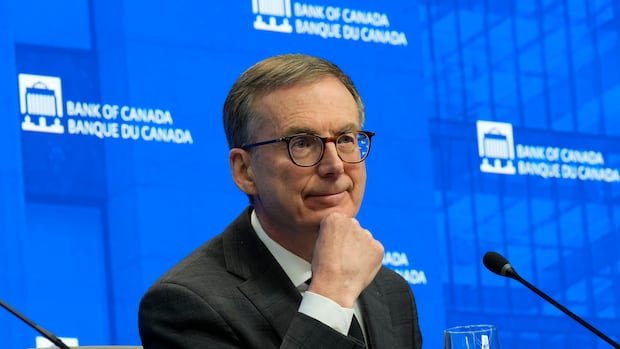
The Bank of Canada has decided to maintain its key interest rate at 2.25 percent for the second consecutive meeting. However, the bank’s future course of action may be influenced by the ongoing trade negotiation risks with the United States and Mexico.
Governor Tiff Macklem stated during a news conference in Ottawa that the central bank’s economic outlook has not changed significantly since its October projection. Macklem highlighted the heightened uncertainty surrounding the forecast, citing unpredictable U.S. trade policies and increased geopolitical risks.
The upcoming review of the Canada-U.S.-Mexico Agreement (CUSMA) is a significant source of economic uncertainty and a key risk factor for Canada’s economic outlook, according to Macklem. He emphasized the need for Canada to adapt to the end of open, rules-based trade with the United States.
Macklem also warned that Canada’s efforts to diversify trade may not fully offset the “structural” damage caused by the U.S. trade war. When asked about the potential impact of the CUSMA negotiation on future interest rate decisions, Macklem acknowledged that it represents a crucial risk to the bank’s projection.
The central bank’s current economic forecasts are based on a scenario where U.S. tariffs on Canada remain in place, and certain CUSMA-related exemptions maintain some level of free trade with the U.S. However, Macklem noted that this could change following the review.
Macklem expressed concerns about the threats to the independence of the U.S. Federal Reserve, stating that such uncertainties contribute to heightened economic uncertainty globally. He emphasized the importance of a functioning U.S. Federal Reserve for the global economy, including Canada.
Economist Joseph Brusuelas predicted that interest rates would likely remain unchanged for the rest of the year. However, he highlighted the potential for contention during the upcoming CUSMA review, suggesting that any policy shift by the central bank could lean towards rate cuts in response to various economic factors.
Looking ahead, the Bank of Canada expects modest GDP growth in 2026-2027 due to a slowing Canadian population growth and adjustments to U.S. protectionism. Despite challenges from U.S. tariffs affecting Canadian exports, domestic spending is showing signs of improvement, and business investments are expected to rebound.
The central bank projects annual average GDP growth of 1.1 percent in 2026 and 1.5 percent in 2027, aligning with its previous projections. While the current interest rate is deemed appropriate to maintain inflation near target levels, the bank remains prepared to adjust its stance based on evolving economic conditions.
Avery Shenfeld, chief economist at CIBC Capital Markets, noted that the bank’s decision to maintain interest rates reflects concerns about trade uncertainties and a deceleration in underlying inflation. Shenfeld maintained a forecast of no interest rate changes in 2026 but suggested a higher likelihood of a rate cut given the economic uncertainties ahead.

