
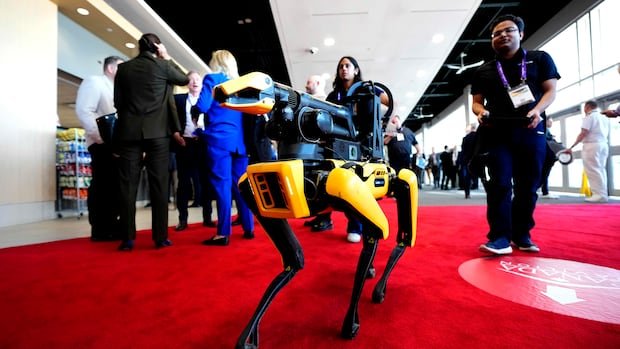
A global competition is in progress to integrate robotics into daily life, with a new wave of AI-driven robots offering enhanced adaptability. The rapid progress in artificial intelligence has led to robots being utilized for various tasks, from collaborating with humans in warehouses to delivering packages in urban settings and inspecting hazardous areas.
Notably, robots are now capable of learning on the job, presenting an opportunity that Canada risks missing out on if not promptly embraced. The current buzzword in artificial intelligence is “physical AI,” a concept prominently showcased at the recent Consumer Electronics Show (CES).
During CES, Google and Boston Dynamics revealed a collaboration to test AI-powered robots in Hyundai auto plants, featuring two versions of a robot named Atlas. While the development of general-purpose humanoid robots for household chores like dishwashing and laundry folding is still distant, AI is increasingly transitioning into the physical realm.
Traditionally, robots are programmed in a linear manner for specific tasks suited to controlled environments like factory settings. However, a novel approach inspired by generative AI allows robots to be trained in a more flexible manner, enabling them to learn dynamically on the job.
This method opens up robotics adoption to smaller enterprises that prefer a simpler, plug-and-play approach without extensive coding requirements. According to Hallie Siegel, CEO of the Canadian Robotics Council, embedding intelligence into the robot’s processes enables autonomous learning and task completion without explicit coding.
This evolution enables robots to swiftly adapt and handle more complex tasks requiring reasoning and cognitive abilities. For instance, autonomous vehicles can undergo training in virtual environments to navigate safely in dynamic settings.
Despite the pivotal advancements in robotics technology, experts highlight Canada’s lag behind global leaders, particularly China. China has emerged as a frontrunner in industrial robotics, with over half of the world’s installed industrial robots located in the country. The rapid localization of robotics manufacturing in China has positioned it ahead of other nations.
The global robotics market, valued at nearly $50 billion US in 2025, is projected to reach $111 billion US by 2030. However, Canada’s industrial robotics adoption falls short, ranking 13th globally. The automotive sector aside, Canada struggles to keep pace with other nations in robotics integration.
Canadian companies face hurdles in marketing robotics domestically, often resorting to international markets for growth. Despite developing advanced robotics solutions, companies like Avidbots primarily deploy their products outside Canada due to market limitations.
Challenges in Canadian robotics adoption include a lack of familiarity with the technology and restrictive regulatory frameworks. The slow pace of innovation deployment in Canada contrasts with more permissive environments like the U.S., hindering the sector’s growth potential.
Industry advocates, such as the Canadian Robotics Council, advocate for a national robotics strategy to enhance Canada’s competitiveness in the global robotics landscape. While Canada is focusing on a broader AI strategy, industry experts emphasize the need for targeted measures in training, incentives, and funding to bolster the country’s robotics sector.

