
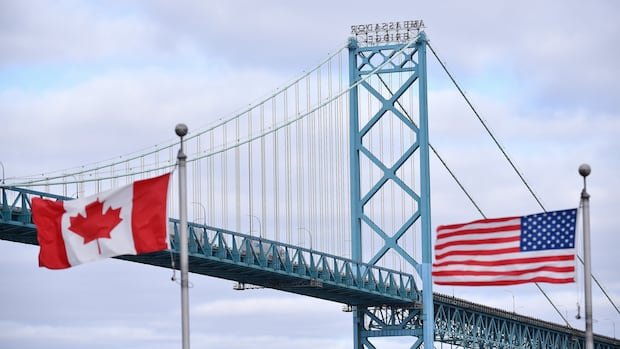
Despite concerns surrounding the U.S. trade war and President Donald Trump’s rhetoric on Canadian autonomy, the largest pension funds in Canada maintain significant investments in the United States. The Canada Pension Plan (CPP), the country’s leading pension fund, recently disclosed that its assets have reached a record $780.7 billion, with 47 percent allocated to U.S. investments, surpassing the 13 percent earmarked for Canadian investments. The proportion of U.S. holdings has remained steady since Trump’s return to office, as per the latest third-quarter results released on Friday.
Since 2005, when Ottawa eliminated restrictions on foreign holdings in Canadian pensions and RRSPs, the CPP’s U.S. investments have experienced consistent growth. Presently, the CPP has $366 billion invested in the U.S. compared to $98 billion in Canada.
An analysis by CBC revealed that the CPP is not the only major pension fund with significant U.S. assets among the so-called “Maple Eight,” which collectively manage $1 trillion in U.S. investments. For instance, OMERS (the Ontario Municipal Employees Retirement System) has 55 percent of its portfolio in American assets, while the Public Sector Pension (PSP) has 40.5 percent allocated to the U.S. Only three of the Maple Eight have more Canadian assets than American, including the Healthcare of Ontario Pension Plan, the Ontario Teachers’ Pension Plan, and the Alberta Investment Management Corp.
Responding to inquiries about the fund’s U.S. investments, CPP spokesperson Michel Leduc acknowledged growing investor anxieties regarding geopolitical risks. Emphasizing the CPP’s long-term investment approach, Leduc stated, “We are not easily swayed by current events or economic fluctuations, even as we closely monitor uncertainties to mitigate excessive risks.”
Leduc highlighted that the CPP’s 47 percent U.S. allocation is below the average compared to prominent global investment diversification benchmarks like the MSCI World Index and the Financial Times Stock Exchange 100, both comprising 65 percent U.S. content.
Daniel Brosseau, president of Letko Brosseau Global Investment Management in Montreal, underscored the broader economic impact of pension funds, noting that they influence various aspects of the economy beyond retirement funding. Brosseau, along with 90 investment leaders, advocated in 2024 for the government to introduce incentives for Canadian pension funds to increase domestic investments, citing substantial available capital for investment in Canada.
Senator Clément Gignac, an economist, pointed out shifting dynamics prompting Canadian pension funds to reassess their U.S. holdings, citing increased uncertainties and new investment prospects in Canada. The Maple Eight fund managers met with Canada’s finance minister in Toronto earlier this year to explore new investment opportunities and encourage more domestic investments.
While there have been calls for regulations to promote Canadian investments, Finance Minister François-Philippe Champagne indicated that the pension funds are voluntarily considering increased investments in Canada, recognizing the benefits of diversification. Keith Ambachtsheer, from the International Center for Pension Management at the University of Toronto, advocated for the elimination of foreign investment restrictions, highlighting the benefits of global portfolio diversification.
Despite the significant U.S. investments, CPP reported a commendable average annualized return of 8.4 percent over the past decade, demonstrating consistent performance amid geopolitical uncertainties.
Looking ahead, the Maple Eight pension funds are closely monitoring developments in the U.S. while exploring opportunities in Canada, particularly in transformative projects. The funds prioritize low-risk investments that offer predictable returns, focusing on sectors like infrastructure, utilities, and airports to ensure long-term financial stability.

