
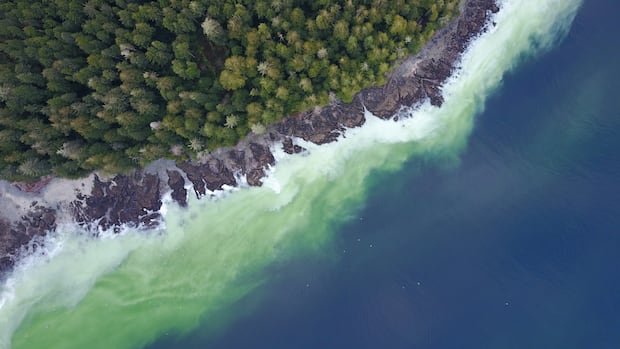
Ryan Cutler observed the ocean turning foamy from his residence near Salmon Beach on the western coast of Vancouver Island recently, signaling the onset of the herring spawn. Cutler, capturing the spectacle with his drone, witnessed the distinctive foamy, milky blue-green water indicating the gathering of herring for reproduction in the shallow coastal bays.
The herring spawn is a significant period for Vancouver Island and the South Coast, symbolizing the arrival of spring and a time for food gathering for some coastal First Nations. This event is crucial for marine conservationists to monitor the declining numbers of herring due to overfishing over the past few decades.
Herring, a pivotal species that congregates in large numbers to spawn, have females laying eggs on kelp and eelgrass while males release milt, giving the water a milky appearance. Cutler noted signs of staging, where herring assemble and prepare to spawn, evident in the presence of sea lions, eagles, and humpback whales in the area.
Nick Chowdhury, president of the Island Marine Aquatic Working Group, emphasized the importance of the herring spawn for coastal First Nations as a time for food gathering and a seasonal transition. The tracking of the spawn’s occurrence aids in evaluating fish stocks and observing the return of spawning to areas after an absence.
Long-time fisher Shirley Louie, a member of the Stz’uminus First Nation, embarked on learning about herring through a documentary project with the Q’ul-lhanumutsun Aquatic Resources Society (QARS), focusing on catching and preparing herring traditionally. Louie’s engagement in using a herring rake and rediscovering traditional foods highlights the cultural significance of herring in coastal communities.

