
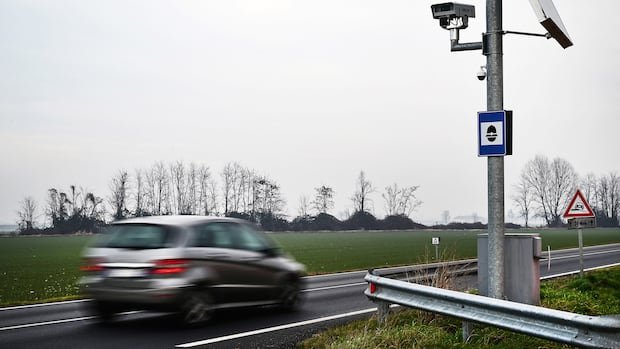
In a suburban town near Padua, Italy, on a winter day in 2024, commuters were surprised to find a speed camera vandalized by an angle grinder, displaying the message “Fleximan is coming.” This incident marked the beginning of a series of similar attacks on speed cameras, leading to the rise of the mysterious figure, Fleximan, who gained a legendary status in Italy.
Despite the notoriety surrounding Fleximan’s actions, there is a widespread consensus across Europe that speed cameras are effective and necessary. Jenny Carson, a project manager at the European Transport Safety Council (ETSC) in Brussels, Belgium, highlighted the strong public support for enforcing speed limits as a means to enhance road safety.
Italy, with over 10,000 operational speed cameras, stands as a testament to the positive attitude towards stricter speeding regulations. Despite data showing that almost half of Italians admitted to speeding in the past month, a 2018 European survey revealed that nearly 70% of Italians favored more stringent speeding rules.
Comparing Europe’s approach to speed camera implementation with Ontario Premier Doug Ford’s stance, it raises the question of how Europe successfully garnered broad backing for automated enforcement systems that have the potential to save numerous lives annually.
The French experience is a prime example of successful speed camera implementation. Following a series of high-profile traffic accidents in 2002, French President Jacques Chirac prioritized reducing traffic fatalities, resulting in the deployment of over 2,400 operational cameras in the country. This underscores the importance of political commitment in building the necessary infrastructure for enforcing speed regulations effectively.
France adopted a dual-camera system, consisting of fixed cameras for preventive measures and mobile cameras for punitive actions, demonstrating the efficacy of deterrence in improving road safety. This approach has led to significant reductions in average speeds and a decline in road accidents across Europe.
While speed cameras have shown positive results in Canada, with reported reductions in average speeds around camera locations, concerns arise regarding the enforcement of minor speeding violations. This has led to growing opposition to speed cameras in France, where vigilantes have targeted and damaged a significant portion of the camera network.
To address such challenges, experts emphasize the need for targeted and transparent enforcement strategies, focusing on outliers who pose a significant risk on the roads. However, the effectiveness of speed cameras also hinges on setting meaningful speed limits that align with road conditions and driver behavior.
In conclusion, the debate over speed cameras continues in Europe and beyond, with varying opinions on their efficacy and fairness. Despite the growing resistance, proponents argue that automated enforcement remains a crucial tool in curbing reckless driving behaviors and promoting road safety.

