
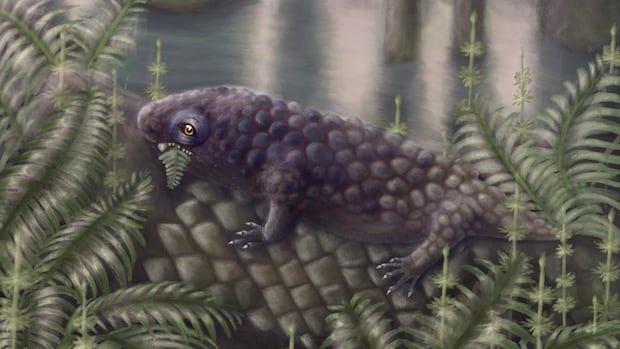
A recently discovered creature, roughly the size of a football, known as Tyrannoroter heberti, showcased herbivorous characteristics ahead of its time. This ancient vertebrate, dating back around 307 million years to the late Carboniferous Period in Nova Scotia, marks one of the earliest plant-eating tetrapods identified.
The findings from a recent study shed light on this pioneering herbivore, challenging existing notions of vertebrate dietary evolution. The lead author, Arjan Mann, emphasized the significance of this discovery in reshaping our understanding of the transition to herbivory in early tetrapods.
Tyrannoroter, classified as a microsaur, shares similarities with reptiles and mammals predating their existence. Unearthed among fossils entangled in the roots of a massive petrified tree stump on Cape Breton Island, this creature’s skull resembles that of pantylids, a group of microsaurs known for their digging adaptations.
Distinctive features of Tyrannoroter include rows of “Hershey-kiss” shaped teeth, specifically adapted for consuming plant matter like shoots and leaves. The teeth, equipped with multiple rows for grinding surface area, hint at an early specialization in plant-based diets among these ancient animals.
The study suggests that Tyrannoroter’s herbivorous tendencies might have evolved from insect consumption, indicating a gradual transition to plant-based diets among early tetrapods. The unique body structure of pantylids, like Tyrannoroter, hints at the potential presence of cellulose-digesting microbes in their guts, facilitating herbivorous habits.
These findings not only provide insights into ancient dietary preferences but also offer valuable information for evolutionary studies. Understanding the emergence of herbivores and their impact on ecosystems can aid researchers in unraveling the intricate web of plant-animal interactions throughout history.

