
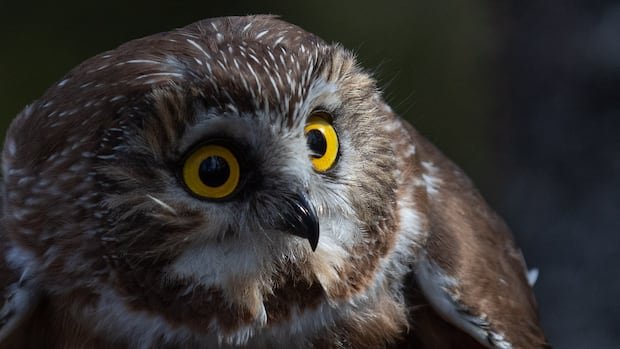
The recent heavy snowfall in Nova Scotia this winter is causing some of the province’s smallest owls to venture into more populated areas in search of food. The Northern saw-whet owl, which is tinier than a robin, is having trouble hunting its usual prey of mice, voles, and shrews due to the snow cover, as noted by Randy Lauff, a biology instructor at St. Francis Xavier University specializing in boreal and Northern saw-whet owls.
Owls, known for their keen eyesight and exceptional hearing abilities, possess unique predatory skills. While larger owls can detect rodents moving beneath thick snow layers and use their size and strength to catch prey with precision, the small saw-whets face challenges due to their size.
As a result of the food scarcity, saw-whet owls are being sighted more frequently this winter in both rural and urban settings with bird feeders. These owls are not after the seeds but are attracted to the mice and small birds drawn to the feeders.
Despite the perception of a snowier and longer winter in Nova Scotia, CBC meteorologist Ryan Snoddon indicates that the current snow levels are consistent with typical winters, with additional snowfall received on Monday possibly altering the situation.
Recently, Hatfield Farm in Hammonds Plains, N.S., encountered a saw-whet owl on its premises for the first time, seeking potential prey in the barn. Cherie Hatfield, the owner, mentioned that the owl may have been searching for small creatures around the barn due to the increased snow cover and the heightened predator activity during winter.
Lauff advises Nova Scotians who spot saw-whet owls in their yards to admire them briefly and give them space to avoid causing stress. In an effort to protect the owls from disturbances, the Nova Scotia Bird Society has restricted members from posting photos of saw-whet owls on their Facebook group.
Snow cover can be both advantageous and challenging for birds of prey, according to Hope Swinemar, the founder of Hope for Wildlife in Seaforth, N.S. While the contrast between dark-colored prey and white snow aids in visibility, icy snow crusts can impede access to food, potentially leading to higher starvation rates.
Swinemar noted that, despite no significant increase in saw-whet owls requiring assistance this year, there has been an uptick in cases involving barred owls, likely due to road-hunting activities resulting in collisions with vehicles.
In summary, the wildlife expert emphasized that birds and animals are well-equipped to cope with harsh winter conditions, highlighting their adaptability and resilience compared to humans.

