
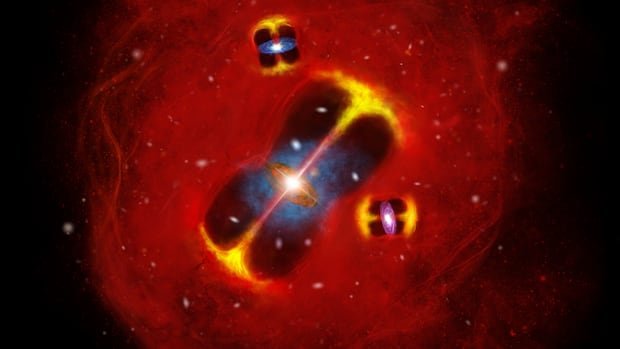
A group of international scientists, led by an astrophysicist from the University of British Columbia, has identified a young galaxy cluster generating hot gas at a rate five times higher than previously believed possible. This groundbreaking finding has sparked excitement among astrophysicists, potentially reshaping perspectives on the early universe post-Big Bang.
The study, featured in the Nature journal, engaged over two dozen researchers worldwide and scrutinized the galaxy cluster SPT2349-56 located approximately 12 billion light years away. Headed by UBC PhD candidate Dazhi Zhou, the team observed a notable presence of hot gas within the intergalactic space.
Zhou highlighted the significance of detecting such hot gas at an early cosmic stage, given the cluster’s youthful age of 1.4 billion years post-Big Bang. Describing it as a significant advancement in comprehending universal mechanisms, Zhou emphasized the study’s impact on scientific understanding.
James Di Francesco, director of the Dominion Astrophysical Observatory near Victoria, noted that conventional theories did not anticipate galaxy clusters reaching such high temperatures swiftly. He pointed out that the typical expectation is for intergalactic gas to heat gradually over time due to galactic movements injecting energy into the surrounding gas.
The revelation of intense gas heating in this early cluster challenges previous assumptions, offering a novel perspective on cluster evolution and defying anticipated trends. This discovery opens a new window into early universe dynamics, as per Di Francesco’s assessment.
The researchers’ findings suggest that the volume of hot gas detected existed billions of years after the formation of the SPT2349-56 galaxy cluster. Utilizing telescopes in Chile, the team delved into dark clouds, deepened insights into star formation, and explored the universe’s primordial era.
Zhou explained that the use of radio telescopes enabled precise observations of the gas’s temperature, despite its considerable distance from Earth. By employing short wavelengths like submillimeter and millimeter, scientists could scrutinize the gas properties accurately.
Galaxy clusters encompass a congregation of galaxies, varying from clusters to superclusters containing hundreds to thousands of galaxies. The Milky Way, part of the Virgo supercluster potentially housing over 2,000 galaxies, illustrates the scale of these cosmic structures.
Zhou emphasized the pivotal role of this research in deciphering contemporary massive galaxy clusters and their developmental processes. This study sheds light on the intricate mechanisms governing the universe’s evolution and sets the stage for further astronomical breakthroughs.

