
The Voyager 1 robotic space probe, which holds the record for being the farthest object launched from Earth, is set to reach a distance of one light day away from Earth next year, marking a nearly fifty-year journey to achieve this milestone. Alongside its companion, Voyager 2, these intrepid spacecraft are currently positioned over 23 billion kilometers away from Earth. By November 2026, it will require a full day for a radio signal, traveling at the speed of light, to reach Voyager 1 and another day for a signal to return back to Earth. Consequently, scientists at mission control must endure a two-day waiting period just to confirm the spacecraft’s operational status. Voyager 2, following a slightly slower trajectory, is anticipated to reach this milestone in another ten years.
Launched from Cape Canaveral in 1977 with a primary mission to explore the outer planets Jupiter and Saturn, Voyager 2 continued its journey to Uranus and Neptune, becoming the sole spacecraft to visit these distant worlds. The gravitational influence of these massive planets provided the Voyagers with the necessary velocity to break free from the sun’s gravitational pull. Currently, they are departing our solar system at speeds exceeding 60,000 km/hr, a rapid pace relative to Earth’s standards but relatively sluggish within the context of the galaxy.
The Voyager missions were driven by a spirit of pure exploration, akin to historical explorers like Magellan venturing to discover new worlds across the seas, except in this case, unveiling new worlds beyond Earth’s realm. Instead of halting at the planets, the Voyager spacecraft swiftly flew past them, capturing numerous photographs and scientific data en route, resembling a sightseer on a tour bus snapping pictures through the windows.
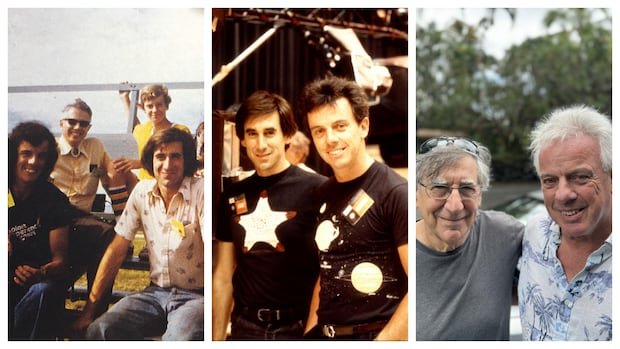
The voyage to Neptune at the solar system’s edge took Voyager 2 twelve years, during which observers like Jon Lomberg and Bob McDonald witnessed the passage of time, showcasing the prolonged journey across the solar system. The technological tools used for reporting on the mission evolved from typewriters at the launch to powerful portable computers that outstripped the spacecraft’s technology by the time they reached Neptune.
While the Voyager spacecraft continue their interstellar odyssey, individuals like Jon and Bob have aged, reflecting on the significant time spent in space exploration. The vast distances in space, exemplified by the decades-long journey to cover just one light day, underscore the immense scale of the universe, where distances are measured in light years.
Considering Voyager 1’s five-decade-long expedition to reach a single light day, extrapolating this duration to one light year, equivalent to 9.46 trillion kilometers, would amount to 18,250 years of travel. This perspective highlights the immense distance to our closest star, Proxima Centauri, situated 4.25 light years away, a journey that would take Voyager approximately 77,562 years to complete. To put this into context, 77,000 years ago, Neanderthals roamed the Earth.
For those aspiring to traverse the Milky Way Galaxy and reach its center’s black hole, encompassing a distance of roughly 30,000 light years, or venture to its farthest point at 100,000 light years away, the time required for Voyager to cover such vast distances would surpass the age of the Earth’s existence.
The enormity of space and the protracted durations needed for space travel evoke a sense of humility, akin to children taking their first tentative steps among the stars. While advancements in propulsion systems like plasma rockets offer prospects for faster interplanetary travel, the pace remains leisurely in the grand scheme of interstellar travel.
Reflecting on the Voyager launch event, observers contemplated the enduring journey that these spacecraft would undertake among the stars. Despite the passage of time, both Voyager spacecraft are anticipated to remain intact for over a billion years, preserving their legacy as enduring pioneers in space exploration. The vastness of space, coupled with the gradual progression of space travel, serves as a poignant reminder of humanity’s humble beginnings among the celestial bodies.

