
Adriana Avelina Ruíz Márquez employs artificial eyelash adhesive to affix a miniature transmitter to the thorax, just behind the head, of the monarch butterfly. Weighing approximately half a gram, the butterfly effortlessly carries the 60-milligram device, which features a solar panel the size of a grain of rice.
After the delicate operation, which involves a toothpick and a Q-Tip, the butterfly takes flight following its release by Ruíz Márquez, who serves as the deputy director of the Monarch Butterfly Biosphere Reserve. This new tracking device, utilized in Mexico for the first time to tag monarchs before their migration back north to the U.S. and southern Canada, is expected to shed light on mysteries surrounding the insects, with the assistance of people’s smartphones for tracking purposes.
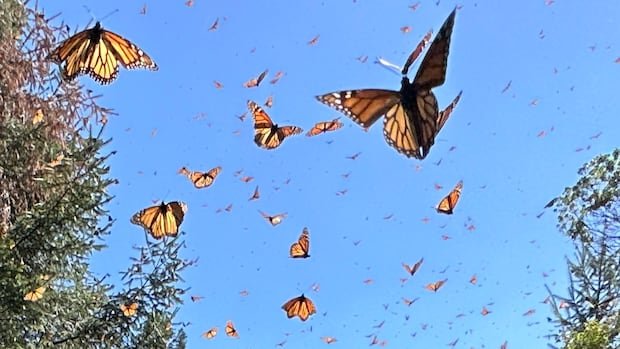
Ruiz Márquez expressed her belief in the potential of this technology to unveil secrets about the migration route, activities upon arrival, and departure patterns of the monarch butterflies. The monarchs predominantly overwinter in El Rosario, one of six sanctuaries within the Monarch Butterfly Biosphere Reserve, located in Michoacán.
Teams from the federal Commission for National Natural Protected Areas and World Wildlife Fund (WWF) Mexico have tagged a total of 160 monarchs across the reserve, including 40 in El Rosario, with the innovative transmitters. These transmitters will offer unparalleled insight into the initial phase of the butterflies’ northward migration.
Eduardo Rendón Salinas, a biologist with WWF Mexico, highlighted the significance of tracking monarch movement between colonies, a concept previously only theorized. The monarch butterflies undertake a journey spanning up to 5,000 kilometers, requiring three to four generations to complete the migration to their northern destinations.
The new microchipped transmitter emits a signal detectable by nearby iPhones, enabling crowd-sourced tracking of the butterflies’ trajectory when Bluetooth and location functions are activated. This technology allows the Project Monarch app, accessible to everyone, or a handheld receiver to map the butterflies’ path with unprecedented spatial detail.
Previously, scientists relied on wing tags for tracking monarchs, which provided limited information on their movements during migration. A forthcoming enhancement to the transmitter will enable Android smartphones to act as passive detectors, expanding the tracking capabilities.
After successful trials in 2023 and 2024, the transmitters were incorporated into a continent-wide monarch tracking initiative involving over 20 groups. The project commenced in Ontario in September 2025, with 30 monarchs tagged at the Long Point, Ont., UNESCO biosphere reserve, south of Toronto.
The El Rosario sanctuary, land collectively managed by the community, serves as a vital overwintering site for monarchs. The community actively patrols the area to prevent illegal logging and sustains a thriving tourism industry during the monarchs’ stay. This initiative not only supports the local economy but also contributes to the preservation of the sanctuary and its inhabitants.

