
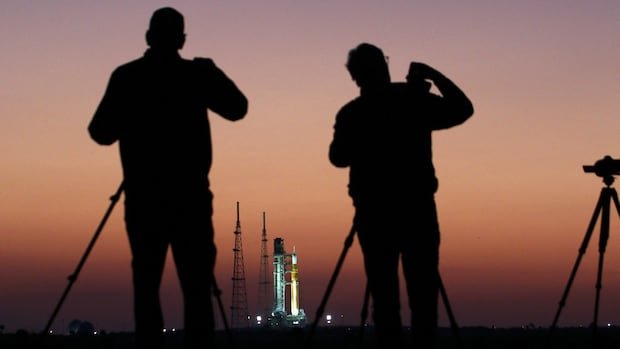
Artemis II is on the verge of embarking on a significant journey circling the moon, potentially surpassing previous human space exploration limits. The mission will feature Canadian Space Agency astronaut Jeremy Hansen, alongside NASA astronauts Reid Wiseman, Victor Glover, and Christina Koch. They will launch aboard the Space Launch System (SLS) rocket within the Orion spacecraft from Kennedy Space Center’s Launch Pad 39B in Florida.
The mission’s timing presents challenges due to multiple launch windows contingent on risk assessments and system clearances. Previous attempts in February and March encountered delays linked to hydrogen and helium concerns, with weather also playing a role. However, NASA indicates an 80% probability of a successful launch on April 1. The optimal orbital trajectory necessitates a nighttime launch, with the initial attempt scheduled for Wednesday, April 1, from 6:24 p.m. to 8:24 p.m. ET. Subsequent opportunities are available each night from April 2 to April 6 if the initial launch is scrubbed.
For comprehensive coverage of the Artemis II mission, CBC News will provide updates on various platforms. Live reports from Kennedy Space Center by CBC Science reporter Nicole Mortillaro, alongside Paul Hunter and Karen Pauls, will offer insights and mission details across radio, TV, and digital channels. Detailed online coverage will commence two hours before liftoff on CBCNews.ca, featuring a live stream of the launch and real-time updates on the mission progress.
The Artemis II mission aims to test critical systems without a moon landing. Originally intended as the final test before Artemis III, recent NASA adjustments now position Artemis IV for a lunar surface landing in 2028. The overarching goal of the Artemis missions is to establish a sustained presence on the moon for scientific research and economic activities, with eventual ambitions of advancing towards Mars exploration.
NASA’s drive to accelerate lunar exploration plans, including proposals for a moon base and revisions to the Artemis mission sequence, stems from the desire to regain momentum in space exploration. This urgency aligns with efforts to counter China’s progress in lunar exploration, where China aims to land its astronauts on the moon by 2030. At present, Artemis II stands as the next milestone, set to span approximately 10 days before returning to Earth’s Pacific Ocean.
For more information, visit the source.

