
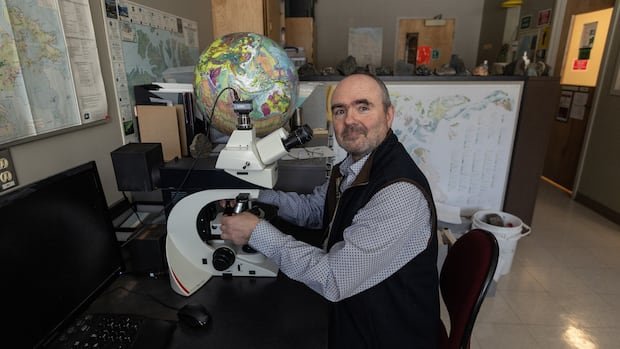
Renowned diamond expert and scientist Graham Pearson’s contributions to the field have been immortalized with the naming of a newly-discovered mineral after him. The International Mineralogical Association officially approved the name “Grahampearsonite” for this mineral found inside a deep-Earth diamond in Brazil.
Pearson, a respected mantle geochemist from the University of Alberta in Edmonton, has dedicated years to studying mantle geology and mineralogy, establishing himself as a leading authority on diamonds and their insights into the Earth’s composition. His extensive research in Brazil, dating back over a decade, has significantly enhanced our understanding of the Earth’s deep mantle, particularly in terms of composition and water content.
Describing the honor of having a mineral named after him as “very humbling,” Pearson emphasized the lasting impact such recognition brings in the scientific community. The discovery of Grahampearsonite within a diamond crystallized at depths exceeding 300 kilometers beneath Brazil’s Juina region revealed a chemical composition of calcium, phosphorus, and oxygen. Previously known as a synthetic material utilized in products like toothpaste abrasive, the natural occurrence of Grahampearsonite marks a significant scientific breakthrough.
Researchers, utilizing advanced X-ray techniques, examined the diamond containing Grahampearsonite, capturing its unique crystal structure. The international research team elected to name the mineral after Pearson in acknowledgment of his exceptional contributions to diamond research. Pearson expressed his admiration for the mineral’s beauty, highlighting the significance of natural-occurring minerals bearing a namesake.
Apart from his groundbreaking work in diamond research, Pearson’s expertise extends to mapping the Earth’s mantle history and developing innovative geochemical analysis methodologies. Raised in a mining town in the UK, Pearson’s fascination with diamonds stemmed from his exposure to mining products and a mentor’s research on rare graphite minerals.
Moving to Canada in 2010 to join the University of Alberta, Pearson established the renowned Arctic Resources Geochemistry Laboratory, furthering his studies on minerals and diamonds in the Arctic region. Emphasizing the importance of ongoing mineral discoveries, Pearson underscored the unique insights natural minerals offer compared to their synthetic counterparts.
Advancements in microscope technology have facilitated the identification of new minerals, hinting at the possibility of uncovering the remaining undiscovered minerals on Earth. With approximately 4,800 minerals already identified, Pearson believes around 4,000 more are yet to be found, signifying a promising future for mineralogical research.

