
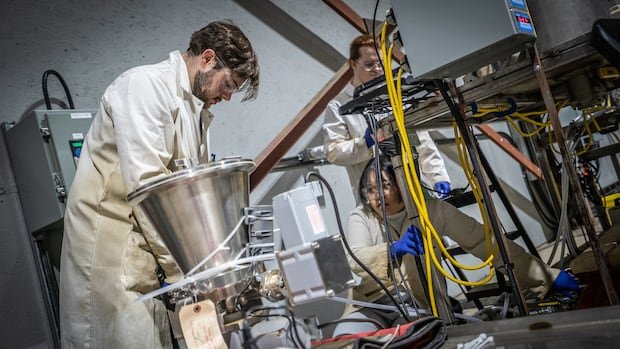
Researchers in Sudbury, Ontario, are focusing on expanding bacteria-powered technology to extract valuable metals from old mine waste on a larger scale. MIRARCO Mining Innovation is currently running a pilot facility to investigate how microbes can break down mine tailings, which are the remaining rock and sediment from mining operations, to release essential minerals like nickel, cobalt, and copper through a process called bioleaching.
Although bioleaching technology is commonly used in international mining with around 30 mine sites globally applying it, Canada has not yet fully implemented it on a commercial scale, as mentioned by Nadia Mykytczuk, the CEO of MIRARCO, the research branch of Laurentian University. Mykytczuk recently showcased the 10,000-square-foot pilot facility in Sudbury to CBC, giving insight into the bioleaching process.
Despite the value of the waste material, companies have not invested in reprocessing the tailings due to the high cost associated with sending the material back to the smelter. Typically, tailings are mixed with water and stored in large ponds, raising concerns about potential long-term environmental risks.
Jaime Kneen from MiningWatch Canada highlighted two main risks associated with storing tailings: chemical behavior and long-term stability. If not managed properly, tailings can generate acid and release metals that may contaminate the surrounding environment. To prevent adverse reactions, tailings are often stored underwater, but this method poses its own risks, such as potential dam failures.
Both the federal and provincial governments are emphasizing the need for critical mineral development to secure supply chains for clean energy technologies and national defense. Mykytczuk sees bioleaching as a solution to meet the demand for critical minerals and address mining cleanup simultaneously.
In a separate lab within the Sudbury facility, researchers are cultivating bacteria specifically designed for bioleaching to target various minerals present in mine waste. The team is conducting experiments to optimize the extraction process and develop high-value products from the extracted metals.
The next phase for the research team involves transitioning from pilot testing to full-scale operations in Canada, with hopes to achieve this within the next two to three years. Despite global examples of successful commercial bioleaching operations, Canada is on the verge of establishing its own full-scale bioleaching facility.

