
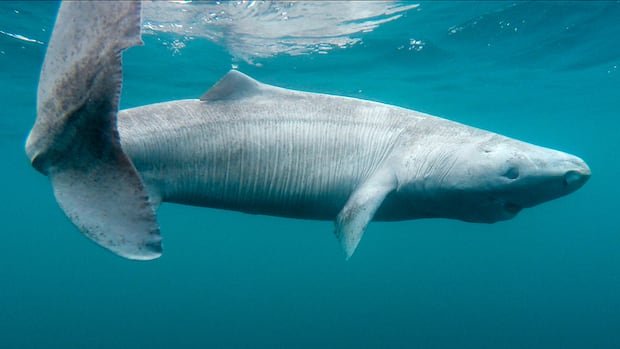

Upon learning that a deceased Greenland shark had washed ashore in northwestern Ireland, zoologist Emma Murphy was astonished.
The massive and ancient ocean creatures are well-known for their elusive nature, typically inhabiting the remote depths of the Arctic and North Atlantic oceans.
“I was truly amazed,” expressed Murphy, a curator of zoology at the National Museum of Ireland, during a conversation with host Nil Kӧksal on As It Happens. “We were absolutely thrilled.”
The museum describes the species as “extremely rare” in Irish waters, marking the first instance of one being stranded on the coast of Ireland.
While Irish researchers examine the remains of the unfortunate shark, one scientist suggests that the species may have a broader distribution than commonly believed.
Longest-Lived Vertebrate in the World
A bystander spotted the shark just outside the town of Sligo on April 11 and reported it to the Irish Whale and Dolphin Group, a conservation organization with a hotline for reporting stranded whales, dolphins, and porpoises.
The individuals who found it initially mistook it for a deceased basking shark, a species frequently found off the coast of Ireland.
Upon identifying the species through photographs, scientists at the organization alerted their counterparts at the National Museum of Ireland in Dublin.
“We were eager to get there as soon as possible,” remarked Murphy.

According to the St. Lawrence Shark Observatory, the Greenland shark is among the largest carnivorous shark species globally, second only to the great white shark. They typically measure between three and five meters in length, with some reaching up to seven meters.
Notably, it holds the title of the longest-lived vertebrate on Earth, with a lifespan exceeding 270 years. The oldest known individual was estimated to be 400 years old.
Broader Habitat Distribution than Expected
Although the primary habitat of the Greenland shark is the cold waters of the Arctic and North Atlantic, including regions like Quebec and Atlantic Canada, shark expert Dean Grubbs suggests that Ireland falls within the species’ known range.
“Given their large size and mobility, as long as the temperatures remain cold, typically below 6 degrees Celsius, there are few obstacles to their movement,” explained Grubbs, the associate research director at Florida State University Coastal and Marine Laboratory, in an email to CBC.
Spending most of their time around 2,000 meters below the ocean’s surface, Greenland sharks are found in various cold locations. Grubbs mentioned instances of researchers encountering them in Belize and the Gulf of Mexico.
“They likely have a more extensive range than currently understood,” he added. “The scarcity of deep-sea sampling hinders frequent sightings.”
‘Exceedingly Beautiful Creatures’
<

