
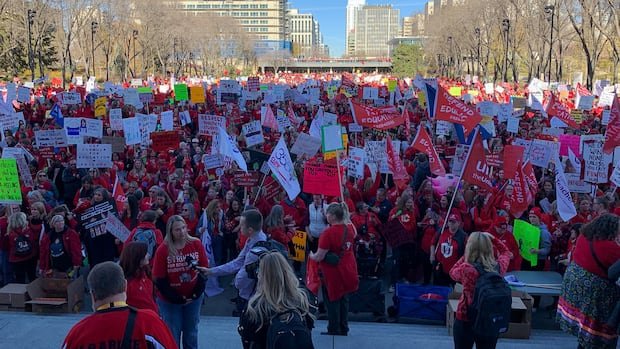
Some educational institutions in Alberta along with an expert in labor relations are expecting a legislative action to be introduced on Monday, directing teachers to return to work and specifying the resumption of classes. Mount Royal University professor Christian Cook mentioned that once the back-to-work legislation is enacted, teachers could be required to go back to schools within 24 to 48 hours, making any strike activity illegal.
The Alberta government has announced that Finance Minister Nate Horner is set to present the Back to School Act on Monday to put an end to the lockout affecting 51,000 teachers from public, Catholic, and francophone schools who initiated a strike on October 6. While the four major school divisions in the province are uncertain about the exact resumption date, they are advising families not to send their children to school on Monday until the legislative process is completed.
Edmonton Catholic Schools anticipates that the forthcoming legislation will outline the timeline for teachers to return to work, as stated by spokesperson Christine Meadows. On Friday, there was no response from the government house leader’s office regarding the timing of the bill’s introduction or the schedule for debate in the legislature on Monday.
The legislation, listed on the order paper, includes provisions that could expedite the legislative process by limiting debate time and advancing the bill through multiple stages in a single day if approved. The opposition party plans to oppose the bill, although the governing United Conservative Party holds the majority vote.
According to Cook, if the government utilizes fast-tracking measures successfully, the bill could be approved as early as Monday or Tuesday. Employers would have the authority to impose penalties on teachers or their association for non-compliance once the law takes effect, as highlighted by Cook, emphasizing the serious repercussions for not adhering to the legislation.
In a similar vein, the back-to-work legislation would end the employers’ lockout that began on October 9. Alberta Teachers’ Association (ATA) president Jason Schilling expressed concerns that the proposed bill would also prohibit teachers from working to rule, emphasizing that returning teachers to work does not resolve the underlying disputes that led to the strike.
Schilling stressed the need for a legal mechanism to ensure sufficient staffing levels in schools to accommodate the growing number of students, particularly those with complex needs. His comments underscored the absence of regulatory measures in Alberta to control class sizes and complexity, which is a critical issue for educators in the province.
Premier Danielle Smith has indicated that the ATA’s demands are rigid, suggesting alternative solutions such as hiring more educational assistants to address classroom challenges. Cook outlined potential negotiation strategies that the government could pursue, including arbitration, which may restrict the scope of issues under discussion, an approach that has been attempted previously by the government.
Critics have condemned the government’s use of back-to-work legislation, citing concerns about infringing on workers’ collective bargaining rights. Nevertheless, if the ATA decides to challenge the law in court, teachers would still be required to report to work during the legal proceedings, as noted by Cook. The impact on collective bargaining rights across the public sector is being closely monitored by all labor unions in the province, reflecting broader concerns about democratic principles.
Regarding the reopening of schools, both Edmonton and Calgary school boards affirmed their readiness to resume classes once teachers return to work. The boards are awaiting guidance from the government on how to make up for lost instructional time and the potential adjustments to the school calendar. Schilling mentioned discussions within some school divisions about teachers returning initially without students to facilitate preparations for the reopening.
Parents expressed mixed feelings about the imminent resumption of classes, with concerns about unresolved issues such as overcrowded classrooms and inadequate teacher support. Despite the anticipation of students returning to school, some parents remain skeptical about the lack of fundamental changes in the education system that have prompted ongoing challenges in the classroom environment.

