
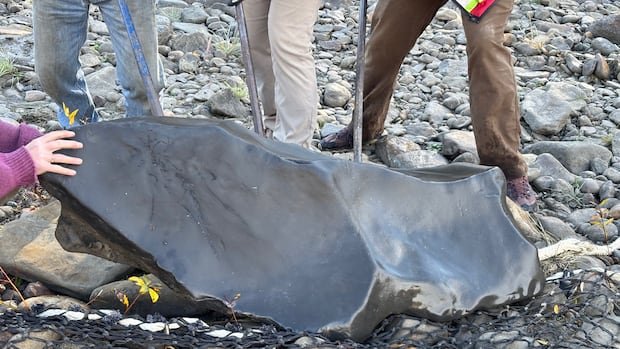
A prehistoric marine reptile skull, identified as an ichthyosaur, was unearthed in the Kiskatinaw River valley in British Columbia, approximately 52 kilometers south of Fort St. John. The discovery was made by local resident Kevin Geist and his 11-year-old son Andreas during a summer expedition two years ago when they noticed a peculiar black rock along the river’s edge in the fossil-rich Peace region.
The unusually low water levels in the Kiskatinaw River, attributed to a prolonged drought over four years, have exposed more rocks, including the one containing the fossilized skull. Geist explained that the dry conditions have led to increased rock exposure, facilitating such discoveries.
Initially unsure of the significance of the find, Geist’s sister-in-law, Diana Hofmann, sent images of the rock to the Tumbler Ridge Museum after revisiting the site this summer. The museum expressed keen interest in the discovery, ultimately confirming it as an ichthyosaur fossil.
Ichthyosaurs, distinct from dinosaurs, are ancient marine reptiles resembling a hybrid of dolphins and fish, well-adapted to aquatic life. The museum’s resident paleontologist, Eamon Drysdale, highlighted the rarity of the skull’s location, suggesting it likely dates back to the Triassic period despite the Cretaceous age of the river valley.
Geologically originating from the Triassic period and possibly transported by a glacier following the formation of the Rocky Mountains, the skull’s journey to the river valley has been a remarkable one, according to Drysdale. The Peace region in northeastern British Columbia harbors a rich fossil record spanning over 500 million years, showcasing a diverse array of ancient life forms.
Drysdale emphasized the potential for more fossil discoveries in the valley due to the glacier’s historical movement, albeit unexplored territories. Airlifted for safekeeping, the ichthyosaur skull was carefully transported to the museum, with community involvement playing a crucial role in the recovery process.
Notably, Tumbler Ridge is renowned for its fossil-rich landscape, housing various paleontological discoveries, including dinosaur remains and ancient footprints. The museum’s continuous efforts to unearth and preserve such historical artifacts underscore the region’s significance in paleontological research and education.

