
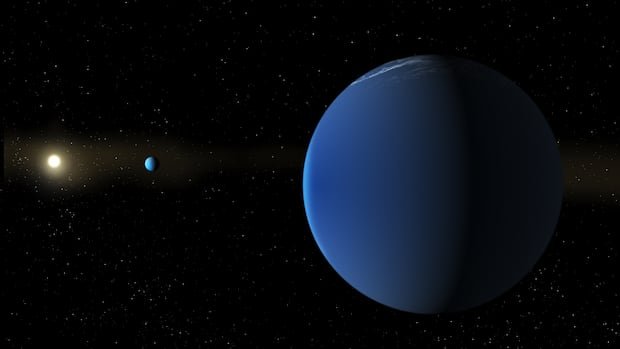
At a distance of approximately 1,113 light years from Earth, two planets orbiting a single star have been discovered, resembling Jupiter in size but with a density similar to cotton candy. These unique exoplanets, known as “super-puffs,” are exceptionally rare due to their remarkably low density.
Lead author George Dransfield, an astrophysicist from the University of Oxford, likened these planets to a blob of shaving foam. The mystery lies in how these unusually large planets maintain their size, as explained by mathematician Antoine Petit from France’s Centre National de la Recherche Scientifique.
Published in the Monthly Notices of the Royal Astronomical Society, the study sheds light on the enigmatic nature of super-puffs in the universe. These planets are a fascinating discovery, with less than 40 known out of nearly 6,300 confirmed exoplanets.
Lisa Dang, an astrophysicist at the University of Waterloo, highlighted the significance of finding two super-puffs orbiting the same star. The internal mechanisms responsible for the expansion of these planets continue to puzzle scientists.
Theories proposed by Nicolas Cowan from McGill University suggest that the age and temperature of super-puffs play a crucial role in their size and composition. These planets challenge existing scientific models, especially if confirmed by further observations using NASA’s Webb Space Telescope.
Detected by NASA’s Tess satellite, the two super-puff planets are located in the Volans constellation and are believed to be composed of hydrogen and helium. Their massive size relative to their mass raises questions about their formation and evolution, prompting further investigation by the scientific community.
Antoine Petit described these sibling planets as a poetic cosmic duo, intertwined in a gravitational dance. While the study’s conclusions await verification through additional research, the potential insights into planet evolution from these super-puffs offer a glimpse into the mysteries of the universe.

