
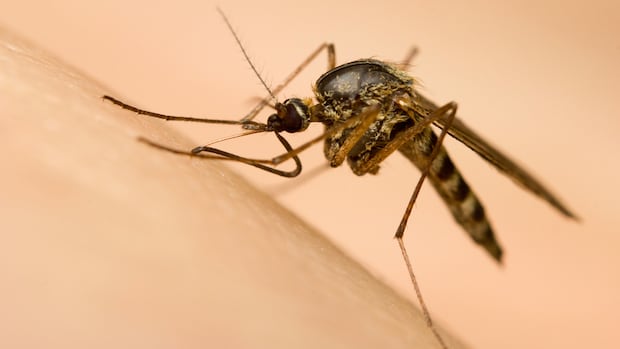
Alberta’s rapidly increasing mosquito populations are causing more than just discomfort and annoyance.
The swarming insects are resulting in a rise in visits to emergency rooms across Alberta, especially among younger patients.
Dr. Andrew Dixon, an emergency room physician in Edmonton, has seen multiple instances of what is known as “skeeter syndrome” this summer.
“Many children have been coming to the emergency department due to mosquito bites. I’ve probably encountered five or six cases in the last couple of days,” he mentioned in a recent interview with CBC News.
“We’ve observed numerous children coming in with considerable swelling. Parents often become most concerned when the swelling occurs near the eye. When the area around the eye becomes puffy and the eye is swollen shut, it naturally causes alarm, but it is generally harmless.”
‘Common occurrence’
When mosquitoes bite, the itching we feel is a result of our body’s reaction to their saliva.
However, some individuals, particularly those who are not frequently bitten, may experience a much more intense inflammatory response.
According to Dr. Mariam Hanna, a pediatric allergist and clinical immunologist at McMaster University, “Skeeter syndrome is more prevalent in younger children.”
“It usually improves as they age, as they encounter more mosquito bites and develop a greater tolerance. Their immune system becomes increasingly familiar with it.”
Dr. Hanna explained that large sections of skin may become very red, swollen, and warm, and in some instances, blisters filled with fluid can develop.
These reactions are most common around preschool age and typically diminish by the time children reach school age, she added.

Dr. Mariam Hanna is a pediatric allergist and clinical immunologist at McMaster University. She is also the pediatrics chair for the Canadian Society for Allergy and Clinical Immunology. (CBC)
“Many families are, in fact, unaware of this condition. Therefore, when it occurs to their child or someone they are familiar with, it can be quite distressing to witness,” she stated.
“It’s not unusual, especially in specific regions of Canada where there are significantly more mosquitoes and bites.”
As per Dr. Hanna, skeeter syndrome is localized in nature and does not result in anaphylaxis, hence it is not life-threatening.
In some cases, a mild fever may accompany it.
As this could also indicate a potential infection, she advises seeking medical attention if it arises or if there are concerns regarding your child’s condition.
Mosquitoes on the rise
At the University of Calgary, John Soghigian has been monitoring mosquito populations closely.
“Calgary has experienced a particularly severe early mosquito season, and it appears that the rest of the province is similarly affected, primarily due to significant rainfall earlier in the year,” noted Soghigian, an associate professor in the veterinary medicine faculty.
“We are encountering a substantially higher number of mosquitoes, with some traps showing counts that are nearly a hundred times greater than this time last year,” he remarked.
Given these mosquito counts, it is not surprising that instances of skeeter syndrome are emerging.
“Edmonton and Calgary have seen a notable influx of population growth from individuals relocating here,” he pointed out.
“If newcomers, particularly children, have not been exposed to mosquitoes previously, they have a heightened risk of developing skeeter syndrome or other allergic reactions to bites.”
Ultimately, the duration of the mosquito swarms will hinge on the amount of additional rainfall, according to Soghigian.
For instance, last year, the mosquito activity ramped up later in the season after a slow beginning.
In the meantime, Dr. Hanna mentioned that there are several ways to manage skeeter syndrome, such as applying ice to the affected area, using over-the-counter steroid cream, and taking oral antihistamines.
If the joints are affected, she suggested that acetaminophen or ibuprofen could alleviate discomfort.
In a recent public service announcement, Alberta Health Services reported that allergic reactions from insect bites, stings, and environmental exposures led to 1,511 visits across 13 hospitals during the months of June, July, and August last year.
Dr. Dixon recommends that individuals reach out to Health Link if they have any concerns.

