
If you find yourself sitting diagonally across from someone at a cashspiel while enjoying your grandmother’s renowned blueberry grunt, it’s likely to escalate into a lively situation.
For those who may need assistance in interpreting that statement, the Oxford English Dictionary (OED) has recently incorporated seven new terms from Canadian English.
Here’s the complete list in bullet points:
- Cashspiel (noun): A contest or event where cash prizes are awarded. Derived from “bonspiel,” it commonly refers to a curling competition among players from various clubs or regions.
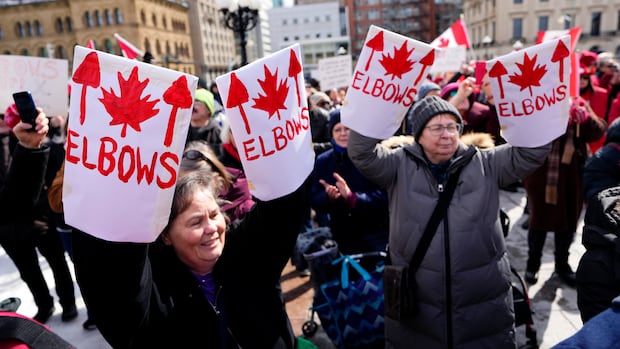
- Elbows up (phrase): Indicates a readiness to defend oneself (often aggressively) or retaliate. Frequently used as a modifier.
- Grunt (noun): A dessert made of stewed fruit topped with a biscuit or dough layer, typically cooked on the stovetop instead of baked. Often accompanied by a descriptor indicating the type of fruit used.
- Kitty-corner (adjective and adverb): Positioned diagonally across from someone or something.
- Kokum (noun): Mainly in Cree contexts: a grandmother; an elderly woman; also used as a term of endearment or address.
- Land acknowledgment (noun): A formal statement, either written or spoken, acknowledging and honoring the original Indigenous people of the land that has been colonized and where an event or institution is situated.
- Point form (noun and adjective): A way of presenting information in a list or series of brief statements.
The OED employs various strategies to monitor the introduction of new words in the English language. Some words are gathered through crowdsourcing, while others originate from researchers examining English usage in Canada. Additionally, the OED utilizes software to analyze word frequency around the globe.
Thus, it’s hardly surprising that “elbows up” was included among this year’s new phrases.

In reaction to U.S. President Donald Trump’s tariffs, Canadian actor Mike Myers may have sparked a movement by gesturing to his elbow and mouthing “elbows up” during his appearances on Saturday Night Live. The phrase gained traction and has become a rallying cry amidst the trade conflict.
How the world perceives Canada
“Working on this set of words has been quite enjoyable,” remarked Danica Salazar, the world English editor at the OED. “Canada has been showcasing a lot of soft power lately, particularly with the Elbows Up movement and Heated Rivalry. Canada has been on the global stage more than ever.”
As these new terms are added to the wider vocabulary, it’s likely that other English speakers will begin to view Canadians in a manner similar to how we perceive ourselves.
“The typical stereotype of Canadians suggests that they are quite polite and often apologetic and self-deprecating,” Salazar noted. However, with the phrase elbows up gaining recognition, she believes people are beginning to see a different side of Canadians. “You stand up for yourself when necessary… You are far from being pushovers.”
Isn’t kokum Cree?
Salazar mentioned that it’s common for English to incorporate influences from other languages it interacts with.
“Given that Canada is a nation rich in Indigenous cultural influences, it’s only natural that some of these additional words find their way into everyday Canadian language.”
The Cree term kokum serves as a prime example of this phenomenon.
What do they call ‘point form’ elsewhere?
The term bullet points is more commonly used, which is also adopted here. The Canadian expression “point form” appears to be a more unique and versatile alternative.
Salazar admitted she had never encountered the term point form before, despite having relatives in Canada.
She now intends to incorporate it into her own language since it can also function as an adjective. “I find it really handy.”

