
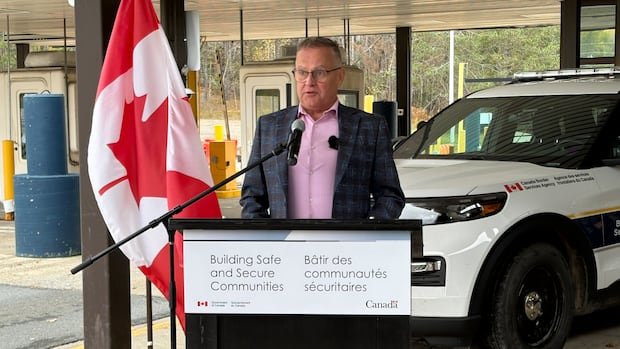
The federal government has unveiled an increase in border security measures that will impact New Brunswick. Wayne Long, the Member of Parliament for Saint John-Kennebecasis, revealed the initiative at the Woodstock-Houlton border on Friday. Commencing in 2025-26, the government will allocate $617 million over five years towards their border strategy, a component of the forthcoming budget scheduled for Nov. 4.
Long emphasized the significance of safeguarding the country’s safety and security at its borders, citing it as a “crucial necessity” given the evolving global landscape with increased risks. As the secretary of state for the Canada Revenue Agency and Financial Institutions, Long highlighted the long-overdue need to fortify the border, strengthen national security, and preserve sovereignty through this funding injection.
The funding is earmarked for the recruitment of 1,000 additional officers for the Canada Border Services Agency, supplementing the existing 10,000 border personnel. Long described the funding allocation as the “most substantial investment in border security in Canadian history.” The initiative also includes enhancements in recruitment procedures.
A notable change involves raising the stipend for CBSA recruits during training from $125 to $525 per week, a figure unchanged since 2005. Additionally, amendments to the Public Service Superannuation Act will grant retirement options to workers after 25 years of service, irrespective of age. This provision extends to various roles, including parliamentary protection officers, search and rescue personnel, federal and territorial firefighters, paramedics, and correctional officers.
Long positioned the announcement as part of a comprehensive border strategy aimed at enhancing community safety by combatting drug trafficking, firearms proliferation, and criminal activities. The initiative aligns with the government’s focus on tackling drug-related concerns, cross-border crimes, and illegal migration to ensure the well-being and security of Canadians, addressing U.S. apprehensions about drug trafficking and fentanyl.
The specific deployment of new officers to New Brunswick is pending, but Long assured increased support for the Port of Saint John. Reflecting on potential impacts at the Woodstock-Houlton border, Superintendent Sylvie Cormier expressed optimism about bolstering community safety through additional staff to facilitate more thorough searches and deter illicit activities.
Despite a recent decline in traffic at the land crossing, Cormier acknowledged a slight uptick post the removal of Canadian tariffs, though numbers remain below typical levels. The overall entry of U.S. residents into Canada by automobile has decreased, as indicated by Statistics Canada’s report showing a 5.3% decline in September compared to the same period last year, marking the eighth consecutive month of year-over-year reductions.

