

As the CFL gears up to roll out a variety of rule modifications and changes to the playing field, a recent poll indicates that overall interest in the league is on the decline.
According to the Angus Reid Institute, the proportion of Canadians who follow the CFL closely or very closely has decreased from 21 percent in both 2014 and 2018 to 16 percent in 2025.
The online survey, conducted from October 7 to 11, was published this week as the Saskatchewan Roughriders and Montreal Alouettes prepare to face off in the Grey Cup on Sunday in Winnipeg.
Among the most dedicated fans of the league, there is a strong preference for maintaining the CFL’s uniqueness, distinguishing it from American football.
In contrast, opinions among less-engaged supporters were more varied — 61 percent of those who do not follow the league closely and 53 percent of casual fans were either uncertain or favored a greater alignment with the NFL, compared to 46 percent of staunch supporters.
On September 22, the CFL announced several rule changes — including an extended play clock, a modified rouge rule, and a smaller playing field — eliciting mixed responses from those caught between the desire to uphold tradition and the need to modernize.
Beginning next season, teams will no longer be able to secure victories through a rouge — that single point awarded when a missed field goal passes through the end zone. A single point will now only be granted if a returner catches a missed field goal, punt, or kickoff in the end zone and either kneels or is tackled while trying to advance the ball.
Additionally, a 35-second automatic reset will be implemented on the play clock. Currently, teams have 20 seconds to execute a play, but the clock generally starts only after officials have placed the ball.
Another adjustment will involve relocating team benches to opposite sides of the field, facilitating easier substitutions. Presently, both benches are situated on the same side.
The most notable changes are set for 2027, when CFL fields will be shortened from 110 to 100 yards, end zones will be decreased from 20 to 15 yards, and goalposts will be moved from the goal line to the back of the end zone.
The survey revealed that two-thirds of devoted fans opposed the alteration to the field dimensions, while half of the casual fans also expressed disagreement.
B.C. Lions quarterback Nathan Rourke labeled the new regulations as “garbage,” criticizing the league for failing to consult with players.
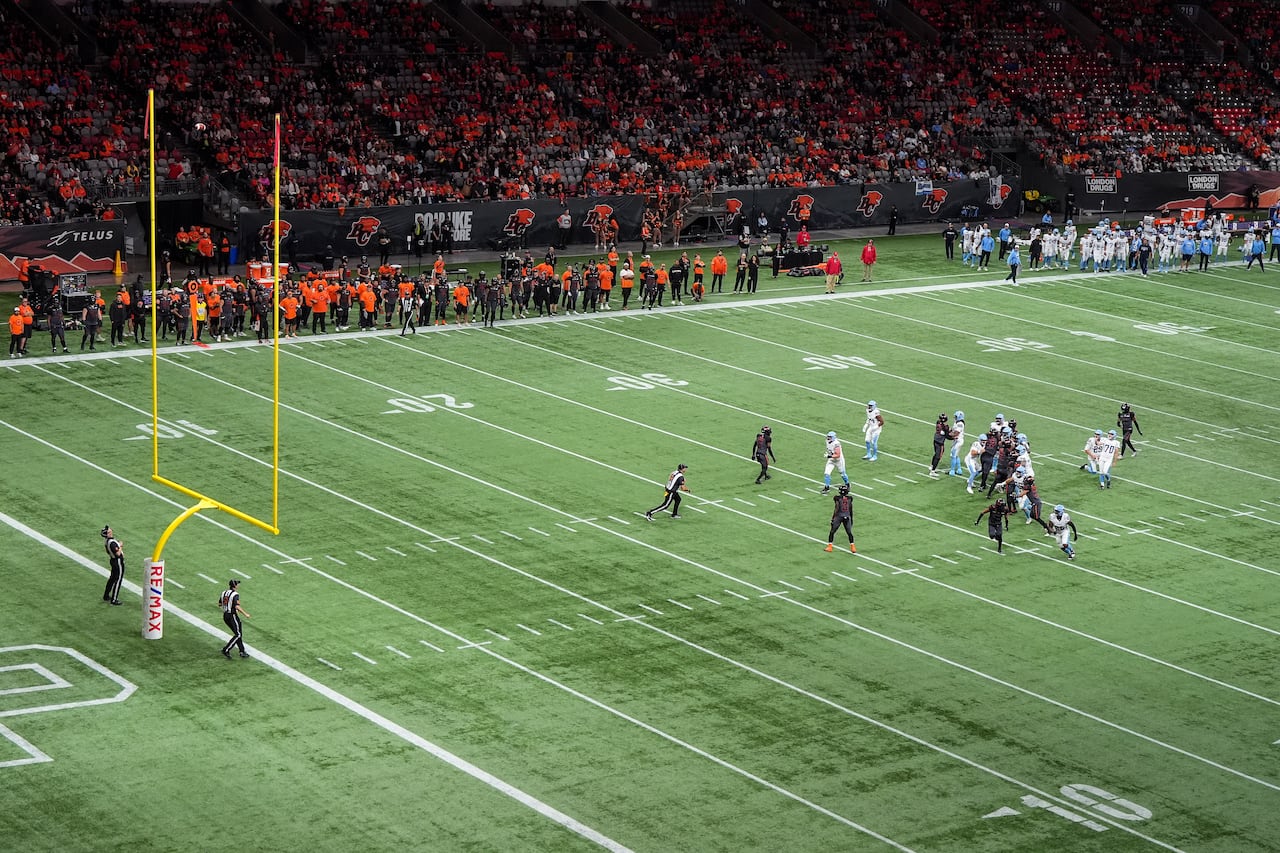
The most significant changes will come in 2027, when CFL fields will be shortened from 110 to 100 yards, end zones reduced from 20 to 15 yards, and goalposts moved from the goal line to the back of the end zone. (The Canadian Press)
In contrast, Hamilton Tiger-Cats quarterback Bo Levi Mitchell held a differing view.
“This isn’t about Americanizing the game — it’s about modernizing it,” stated Mitchell, a veteran of 12 years and a two-time most outstanding player.
“What can we do to present a better product on the field, one that people want to watch, with a faster pace? This does not detract from the unique aspects [of the CFL].”
Montreal Alouettes linebacker Tyrice Beverette acknowledged the forthcoming changes but stated he was not overly concerned.
“I feel like I’m a player regardless of the changes made; I’ll go out there and give my best performance,” he remarked Wednesday during Grey Cup media day in Winnipeg. “The [rule changes] don’t impact me.
“If we all have identical rules, I’m fine with that.”
Saskatchewan Roughriders linebacker Jameer Thurman expressed his support for the changes, noting that the fundamental aspects of Canadian football (12 players, three downs, wider field, maintaining the waggle) will remain intact.
“As a defensive player, I keep reminding everyone that nothing has fundamentally changed for us aside from the goalposts moving to the back,” he commented. “The length of the field, sure, is slightly decreasing.
“But the width stays the same, there are still 12 players on the field, the width remains unchanged, there will still be a waggle, and it will still be three downs. Those are the key elements, and they are not being altered, so I don’t understand the major concerns.
“Shifting the goalposts back provides offensive players with significantly more field to utilize. For us as defensive players, if anything, it merely benefits the offense further.”
The Canadian Research Insights Council, the professional body for the polling industry, states that online surveys cannot be associated with a margin of error due to their non-random sampling of the population.

