
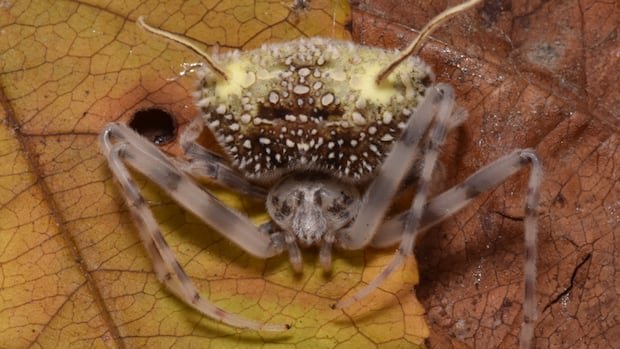
In a surprising turn of events during an August 2025 expedition through the Amazon rainforest, scientist Alexander Bentley encountered a spider seemingly unaffected by what appeared to be a deadly parasitic fungus. Bentley, an experienced herpetologist based in Ecuador, was familiar with cordyceps, the notorious “zombie fungus” known for manipulating its hosts to spread spores akin to creatures from the post-apocalyptic series “The Last of Us.”
Despite the spider displaying two tubercle-like growths on its abdomen, typically a sign of cordyceps infection, further investigation revealed a new arachnid species that mimics fungus such as cordyceps, possibly as a survival tactic. The discovery, detailed in the journal Zootaxa, has garnered excitement among scientists, although some remain skeptical of the spider’s resemblance to the fungus.
Upon observing the spider’s vitality, Bentley turned to the citizen-science platform iNaturalist for insights. Contrary to initial assumptions of fungal infection, specialists identified the creature as a previously unknown spider species named Taczanowskia waska. Collaborating with colleague David Ricardo Díaz-Guevara, Bentley confirmed the species through meticulous morphological analysis.
The revelation of this novel spider species has sparked enthusiasm among experts, underscoring the significance of community-driven platforms like iNaturalist. The spider’s uncanny likeness to fungi has prompted theories of predatory tactics or defensive mimicry, with researchers like Monika Fischer emphasizing the valuable role of citizen science in such groundbreaking discoveries.
While the spider’s appearance continues to intrigue researchers, the exact purpose of its fungal mimicry remains a subject of debate. Experts like Andrew Swafford suggest potential camouflage or defensive strategies, highlighting the need for further investigations to elucidate the spider’s evolutionary adaptations. Regardless of the underlying mechanisms, Bentley regards this finding as a remarkable highlight in his scientific endeavors, describing it as the rarest and most extraordinary discovery of his career.

