
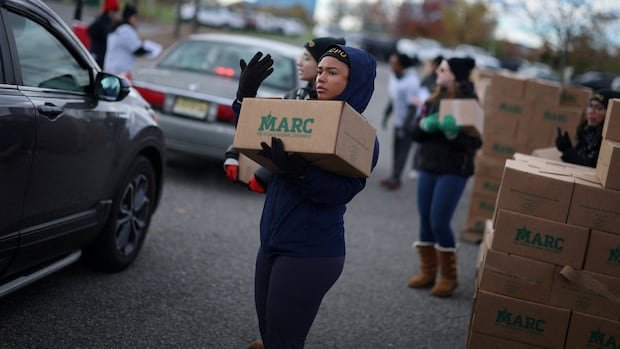
A federal judge has mandated the Trump administration to fully finance this month’s food aid for 42 million low-income Americans by the end of the week, overturning its plan to offer reduced benefits during the prolonged government shutdown. U.S. District Judge John McConnell in Providence, R.I., criticized the administration on Thursday for holding back Supplemental Nutrition Assistance Program benefits, also known as SNAP or food stamps, due to “political reasons.” He directed the U.S. Department of Agriculture (USDA) to ensure people receive their full benefits.
During a virtual court session on Thursday, McConnell stated, “The evidence indicates that individuals will face hunger, food banks will be overwhelmed, and unnecessary suffering will ensue. That’s the essence of irreparable harm in this case.” The Trump administration swiftly appealed McConnell’s ruling, prompting a surprised reaction from Democratic Sen. Patty Murray of Washington.
Expressing her dismay on social media, Murray asserted, “I have never witnessed a U.S. President so determined to allow children and seniors to go hungry. Donald Trump is challenging a federal court’s directive to cover the complete SNAP benefits for this month. This is an extreme and heartless act.”
Trump’s administration sought an appeal from a federal appeals court on Friday to halt any orders requiring additional spending beyond available funds in a contingency account. Meanwhile, Wisconsin Governor Tony Evers’s office confirmed that some SNAP recipients in the state had already received their full November payments overnight on Thursday.
The appeal has stirred uncertainty regarding the ultimate disbursement of SNAP benefits to eligible Americans. The administration criticized the ruling, attributing SNAP compromise to Senate Democrats who opposed a Republican-backed stopgap funding measure to end the shutdown. Vice-President JD Vance condemned the ruling as “absurd” and provided ambiguous signals on the government’s next steps.
Acknowledging the White House’s responsibility in the shutdown, Vance emphasized the need to abide by the law while ensuring government functionality amidst the ongoing situation. The back-and-forth legal proceedings surrounding SNAP benefits have raised questions about the timely and complete delivery of monthly food assistance to households, prompting states to advise recipients on budgeting and visiting food pantries.
In a related case in Boston, Judge McConnell alongside another judge mandated the administration to utilize emergency funding to partially support SNAP benefits. Despite the administration’s initial plan to suspend SNAP benefits entirely in November due to funding constraints, McConnell’s ruling required the use of contingency funds to partially cover benefits.
The administration’s decision to only partially fund SNAP has sparked concerns over the distribution and timing of household food aid, prompting states to address the challenges of implementing reduced benefits. McConnell criticized the USDA for neglecting the administrative complexities associated with reduced benefits and urged tapping into a fund sourced from tariffs to address the issue.
Highlighting President Trump’s apparent defiance of court orders related to SNAP benefits, McConnell emphasized the need to prevent lapses in food aid, emphasizing the avoidable nature of the problem.

