
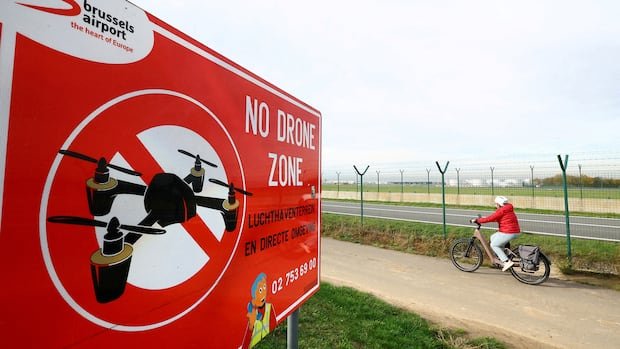
Brussels was already on high alert even before reports emerged of at least three drones hovering over a power plant in northern Belgium on Sunday evening. A series of drone sightings has led to frequent closures of airports in the country, leaving thousands of passengers stranded and planes grounded.
Belgium has become the latest target in a series of mysterious drone incidents across Europe affecting airports and military sites, with some officials directly implicating Russia. This has prompted authorities to urgently enhance their defenses.
According to Belgian media reports, the drones were sighted over the Doel nuclear power plant near the Port of Antwerp over the weekend. However, these reports have not been confirmed by CBC News.
Unlike the situation in September when numerous Russian drones breached Polish airspace during a widespread air attack on Ukraine, there is limited information available about the recent drone sightings.
Jacob Funk Kirkegaard, a senior fellow at the Peterson Institute and Brussels-based think-tank Bruegel, described the situation as a game of “whack-a-mole” or hide and seek, highlighting the drones’ ability to swiftly enter and exit restricted airspaces.
In response to the escalating drone threat, Britain has pledged to send experts and equipment to Belgium to assist in detecting and defending against the drones. The recent closure of Brussels airport due to drone sightings has raised concerns, leading to further suspensions at Belgium’s Liège Airport, mainly used for cargo traffic.
In Germany, where drones disrupted 17 flights at Munich airport in October, authorities are mobilizing rapid-response teams to counter the threat, attributing it to Russia, as stated by the country’s defense minister.
Amidst speculations about the motives behind the drone incidents, Boris Pistorius suggested that Belgium might be targeted due to the ongoing debate surrounding the use of Russia’s frozen assets to support Ukraine, stored at a Belgian clearinghouse called Euroclear.
Russia has dismissed allegations of involvement in launching the drones, with Kremlin spokesperson Dmitry Peskov labeling the accusations baseless, attributing them to a political agenda against Russia.
Guiseppe Spatafora from the EU Institute for Security Studies noted the unprecedented frequency of drone sightings in Europe, linking them to countries supporting Ukraine or contemplating doing so. The recent incidents have raised security concerns, with promises to enhance defenses across affected regions.
NATO has intensified aerial patrols in Poland following violations of Polish airspace by Russian drones, deploying surveillance aircraft equipped with advanced radar systems. Efforts are ongoing to enhance drone detection capabilities, as smaller drones pose a challenge to existing surveillance systems.
European Union officials are emphasizing the need for a region-wide “drone wall” by 2027 to counter the escalating drone threat. However, experts caution about the challenges of intercepting large numbers of agile and inexpensive drones, advocating for a strategic focus on safeguarding critical infrastructure.
Decisions regarding intervention strategies, such as shooting down suspicious drones in urban areas, raise concerns about potential risks and uncertainties associated with such actions.

