
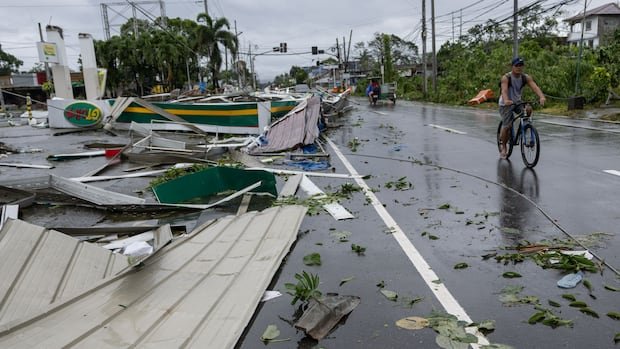
Typhoon Fung-wong has exited the northwestern Philippines, leaving a trail of floods and landslides, causing power outages across entire provinces, and resulting in the deaths of at least eight individuals while displacing over 1.4 million residents. The typhoon is expected to move northwest towards Taiwan.
The storm struck the northern Philippines amid recovery efforts from Typhoon Kalmaegi, which had previously caused widespread devastation and claimed the lives of 224 people in central provinces before hitting Vietnam, where five fatalities were reported.
After making landfall in northeastern Aurora province as a super typhoon with sustained winds reaching 185 kilometers per hour and gusts up to 230 kilometers per hour, Typhoon Fung-wong weakened as it traversed mountainous regions and agricultural areas before moving away from La Union province into the South China Sea.
The impacts of the typhoon included fatalities from drowning, landslides, and collapsed structures in various regions. Emergency shelters housed over 1.4 million people before the storm hit, with approximately 318,000 individuals still in evacuation centers. The storm caused flooding in 132 villages, damaging around 1,000 houses and leading to residents being stranded on rooftops.
President Ferdinand Marcos Jr. declared a state of emergency due to the significant damage caused by the consecutive typhoons. The Philippines classifies storms with sustained winds exceeding 185 kilometers per hour as super typhoons, emphasizing the severity of extreme weather events.
While the Philippines has not requested international assistance following the calamities, the United States and Japan have offered support. School closures, flight cancellations, and port disruptions were implemented as precautionary measures. The Philippines, known for its vulnerability to natural disasters, experiences around 20 typhoons annually, in addition to earthquakes and volcanic activity.
The nation remains vigilant as it continues to face environmental challenges, emphasizing the importance of disaster preparedness and response efforts.

