
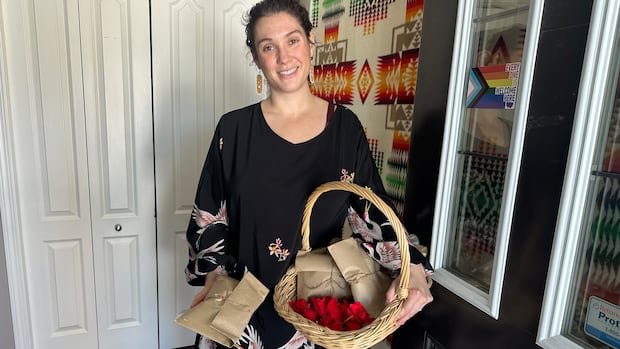
Julietta Sorensen Kass was pleasantly surprised by the success of the tobacco seeds she casually planted in her northwest Calgary lawn. The yield exceeded her needs for cultural ceremonies, prompting her to generously share the excess via social media.
The response to her offer was overwhelmingly positive, with individuals not only expressing interest but also reciprocating with gifts such as cedar and sage bundles. Sorensen Kass, a member of the Manitoba Métis Federation, views tobacco as a sacred plant integral to her ceremonial and prayer practices.
Revered as the “gratitude plant,” tobacco holds a special significance for Sorensen Kass, who uses it to express thanks to nature, animals, and people. She emphasizes the importance of reciprocity in her interactions, believing that giving back to the earth is essential.
Initially hesitant to share her surplus tobacco publicly, Sorensen Kass eventually decided to do so after realizing she had more than she could use. One recipient of her tobacco, Debra Roulette, appreciated the pure quality of the ceremonial tobacco compared to commercial varieties that caused her discomfort.
In exchange for the tobacco, Roulette prepared a batch of traditional fry bread, a gesture that resonated with Sorensen Kass, who enjoyed the treat with her mother. Roulette expressed her desire to delve deeper into her Indigenous heritage by learning to cultivate tobacco, sage, and sweetgrass.
The demand for tobacco seeds has been on the rise, driven by factors such as increasing tobacco taxes and growing interest in organic gardening. Sorensen Kass obtained her seeds from a local nursery and took the time to educate herself on the cultivation process and regulations.
Under federal law, Canadians can grow up to 15 kilograms of raw leaf tobacco per year per adult without a license for personal use. Sorensen Kass faced some complaints about her lawn’s appearance but plans to enhance it with landscaping for future crops.
Despite the challenges of sourcing indigenous plants, Sorensen Kass remains committed to cultivating and sharing tobacco as a way to connect with her culture and community. She finds joy in seeing native plants flourishing alongside tobacco in her yard, symbolizing a sense of liberation.

