
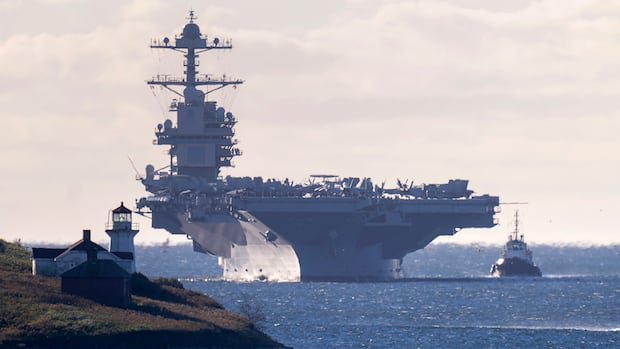
President Donald Trump mentioned on Sunday that the U.S. is potentially engaging in talks with Venezuelan President Nicolas Maduro, indicating a diplomatic approach as the U.S. strengthens its military presence near Venezuela with the deployment of its most advanced aircraft carrier.
While Trump did not provide specific details about the potential discussions with Maduro, he acknowledged that “Venezuela would like to talk.” The U.S. military has been conducting a series of operations targeting vessels suspected of trafficking drugs. The recent arrival of the USS Gerald R. Ford and other warships, as announced by the Navy, signifies a significant development in what the administration describes as a counterdrug operation but is perceived by many as an escalation in pressuring Maduro.
In response to questions about Maduro’s interest in dialogue, Trump simply stated, “What does it mean? You tell me, I don’t know.” He later added, “I’ll talk to anybody. We’ll see what happens.”
Maduro, who is facing narcoterrorism charges in the U.S., has accused the U.S. of orchestrating a fabricated war against him. The deployment of the Ford represents the largest U.S. military buildup in the region in decades, involving nearly a dozen Navy ships and around 12,000 sailors and Marines.
The carrier’s arrival coincided with the military’s announcement of a recent deadly strike on a small boat suspected of transporting illegal drugs. The Southern Command of the military released a video showing the boat being destroyed in international waters of the eastern Pacific Ocean, resulting in the deaths of three individuals. These actions have led to at least 83 casualties in 21 attacks since early September in the Caribbean and eastern Pacific regions.
The carrier strike group, comprising fighter jet squadrons and guided-missile destroyers, transited the Anegada Passage near the British Virgin Islands, according to the Navy. Adm. Alvin Holsey, overseeing the Caribbean and Latin America, affirmed the readiness of American forces to combat threats destabilizing the region.
In Trinidad and Tobago, located just 11 kilometers from Venezuela, joint military exercises with the U.S. have commenced to address violent crime on the island nation, known as a transit point for drug shipments to Europe and North America. Venezuela’s government views these exercises as hostile actions.
Despite U.S. assertions that the buildup aims to stem drug trafficking, no concrete evidence has been presented to support the claim that those targeted in the boat strikes were involved in narcoterrorism. Trump hinted at potential military actions beyond sea strikes, emphasizing the need to prevent drug inflow by land.
Recent statements from U.S. Secretary of State Marco Rubio highlighted the intention to designate Cartel de los Soles as a foreign terrorist organization, attributing its leadership to Maduro and other senior officials. The cartel is accused of perpetrating terrorist activities and drug trafficking in the Western Hemisphere. Rubio’s assertions have been met with skepticism by some experts.
Trump’s authorization of attacks on drug boats, based on the premise of being in conflict with drug cartels, has drawn criticism from regional leaders, UN human rights officials, and U.S. lawmakers seeking transparency and legal justifications. Despite opposition, Senate Republicans rejected legislation that could have restricted Trump’s authority to launch unilateral actions against Venezuela.
Concerns have been raised over the legality and impact of the U.S. boat strikes, with France’s foreign minister condemning them as violations of international law. Canada recently acknowledged the U.S. actions, emphasizing their distinction from joint drug interdiction efforts under Operation Caribbe involving the Canadian military and the U.S.
This ongoing situation has raised tensions and uncertainties, with various stakeholders closely monitoring developments in the region.

