
Meta Platforms has dismissed allegations from U.S. states that it deliberately aimed to create an addictive environment for children on its Facebook and Instagram platforms for financial gain, as a trial that could significantly impact some of the world’s most widely used apps commenced on Tuesday.
A coalition of 29 U.S. states is bringing a lawsuit against Meta, potentially seeking penalties that could reach tens or even hundreds of billions of dollars, alongside reforms to the company’s business practices.
The four primary states involved — California, Colorado, Kentucky, and New Jersey — allege that Meta has engineered Facebook and Instagram to ensnare young users, contributing to mental health issues such as anxiety, depression, and even suicidal thoughts, while misleading users regarding the safety of its platforms. All 29 states have accused Meta of infringing federal laws by improperly collecting and utilizing personal data from children.
Experts have described the trial taking place in a federal court in Oakland, California, which commenced with opening statements on Tuesday, as the most significant legal examination of social media’s impact on younger audiences to date. Meta, along with other social media firms such as Snap, TikTok parent ByteDance, and YouTube parent Alphabet, is facing numerous lawsuits from states, municipalities, school districts, and individuals regarding the potential harm their products may pose to young users.
Megan O’Neill, a deputy attorney general representing California, informed the eight-member jury that Meta’s business strategy is to “capture users, retain them for as long as possible, gather their data, and conceal the reality from the public.”
“This strategy was particularly effective with children,” O’Neill noted. “Meta had a need for young users and had to assure their guardians that those children were secure.”
A landmark U.S. federal trial over youth safety on Meta platforms is now underway. States including California, Colorado, Kentucky and New Jersey are seeking billions of dollars in damages for product designs that are allegedly ‘addictive’ to children. The trial is expected to last at least six weeks, and Meta CEO Mark Zuckerberg and Adam Mosseri, head of Instagram, could be called to testify.
Paul Schmidt, Meta’s attorney, stated that while there is “no disagreement” regarding the challenges some social media users experience, existing research does not establish a definitive connection between the social media habits of adolescents and their overall well-being. He also asserted that Mark Zuckerberg, the company’s co-founder and CEO, shares the goal of enhancing their services rather than making them harmful.
“They understand that their success is tied to user satisfaction,” Schmidt remarked.
Judge may mandate modifications to Instagram and Facebook
The jury is anticipated to deliver an advisory verdict, which is a non-binding recommendation that the judge might consider in her decision-making process; however, U.S. District Judge Yvonne Gonzalez Rogers will ultimately decide Meta’s culpability.
If the court finds Meta at fault, Rogers could enforce civil penalties and mandate alterations to Facebook and Instagram. According to Meta, these fines could potentially reach $1.4 trillion, nearing the company’s market valuation based in Menlo Park, California.
According to attorneys general during a recent hearing, the potential amount could be closer to $200 billion, which represents approximately three years of Meta’s after-tax earnings.
The states of California, Colorado, Kentucky, and New Jersey are also urging Meta to revamp Facebook and Instagram, which includes removing ‘likes’ and the infinite scroll feature that promotes continued viewing of new posts, imposing time restrictions for younger users, and enforcing regulations to keep children under 13 off the platforms.

Meta is investing roughly $13 billion to build its first AI data centre in Canada, located an hour outside Edmonton. The project promises to create thousands of jobs, but has some concerned about its environmental impact.
Initial witness provides testimony
Following the opening arguments, former Meta safety engineer Arturo Bejar commenced his testimony as the first witness for the states.
Bejar has consistently claimed that Meta was aware its child safety measures were ineffective and has previously testified against the company in four different trials. Meta attempted to prevent his testimony, citing his deletion of Signal messages with former colleagues, but Judge Rogers dismissed this attempt, considering it an unlikely effort to disqualify a crucial witness.
Bejar informed jurors that “move fast and break things” was a guiding principle at Meta, which he stated adopted a “don’t ask, don’t tell” policy regarding the oversight of whether children under 13 were using its platforms.
“Numerous products were released without considering safety,” including Reels short-form videos, he remarked, adding that safety was not a factor in their initial deployment.
Employees perceived Instagram as a ‘drug,’ states claim
Both Zuckerberg and Instagram’s head Adam Mosseri are expected to provide testimony. The trial is projected to last six weeks.
On Tuesday, Meta’s stock experienced a decline, closing down 4.4 percent at $543.67.
O’Neill clarified that the states’ intention is not to dismantle Meta’s operations, asserting that social media “offers some advantages for certain users.”
However, she accused Meta of exploiting children by investigating how their brains function and react to online interactions while monitoring their activities on its platforms.
She referenced an internal communication sent to Mosseri that indicated “teen time spent” was a target and mentioned that Meta employees regarded Instagram as a “drug” and themselves as “pushers.”
“Meta discovered that the earlier a child begins using the app, the more advantageous it is,” O’Neill stated.
Schmidt acknowledged that employees might use “relaxed” language in private conversations, but insisted that Meta’s products are not addictive, and that jurors will learn what actions the employee who labeled Instagram a drug took to improve safety.
Protesters gather outside the courthouse
As the trial commenced, several Meta critics gathered outside the courthouse.
Among them was Mary Rodee, whose 15-year-old son, Riley Basford, tragically took his own life in 2021 after being targeted by a predator on Facebook.
“They refer to it as spontaneous suicide,” she stated. “I describe it as what it truly is: a foreseeable outcome of a system that prioritizes corporations over children.”
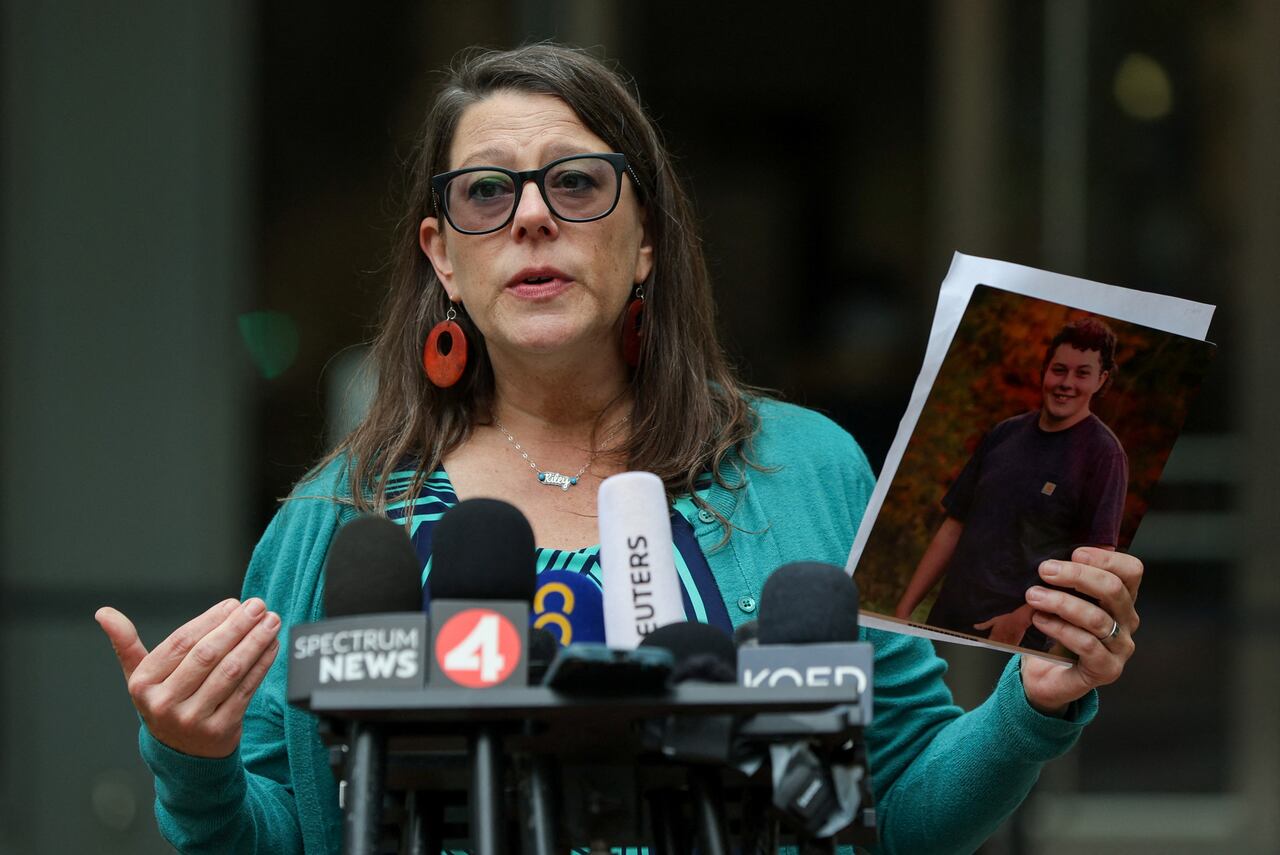
Mary Rodee, mother of Riley Basford, spoke Tuesday outside the Oakland courthouse as parents of children whose deaths were allegedly related to social media use held a news conference to mark the beginning of the trial. (Manuel Orbegozo/Reuters)
The lawsuit was initiated in 2023, two years following whistleblower Frances Haugen’s testimony before a U.S. Senate committee, where she revealed that Meta was aware its products were hazardous for children and knew how to make them safe, yet chose not to act in favor of maximizing profits. In March, a jury in Los Angeles ruled that Meta and Google owed $6 million to a 20-year-old woman who claimed she became addicted to Instagram and YouTube in her childhood.
Earlier this month, a judge in New Mexico ordered Meta to pay $567 million to address the mental health challenges faced by teenagers, after the state’s attorney general labeled its platforms a public nuisance.
Additionally, the attorney general of Tennessee is pursuing legal action against Meta, presenting similar allegations concerning Instagram. That case is currently being heard in Nashville.

