
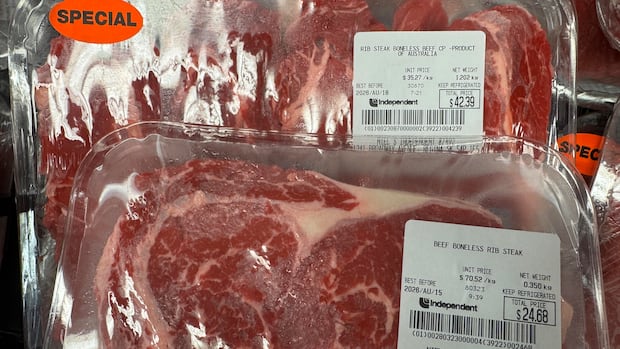
Canadian grocery stores are now stocking Australian beef at significantly lower prices compared to local Canadian beef.
While some local producers express worries about being undercut, many shoppers appreciate the more affordable alternative.
Tyler Fulton, president of the Canadian Cattle Association, noted that Australian beef has been available for several years.
“Lately, consumers have become more aware of this option, especially regarding certain steak cuts,” he explained.
Fulton elaborated on the factors contributing to the price discrepancies in an interview with CBC Saskatchewan.

Tyler Fulton, president of the Canadian Cattle Association, states that Australian beef is addressing a gap in the Canadian market. (Google Meets)
“The production model in Australia is primarily grass-fed with a brief grain finishing phase. This results in a leaner product that lacks the marbling preferred in Canadian beef,” he detailed.
“Another significant factor is that retailers may implement a ‘loss leader’ strategy.”
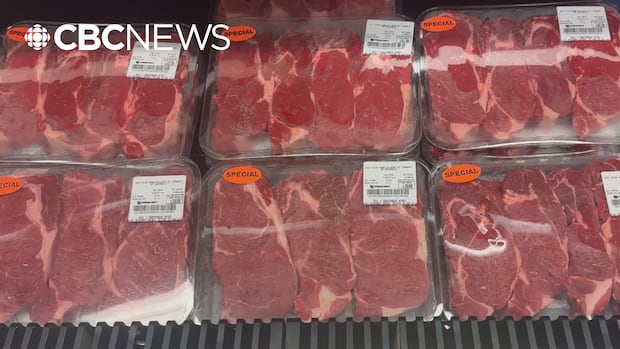
Loblaws grocery stores are offering imported beef at significantly lower prices than local products, raising concerns regarding implications for domestic producers. Tyler Fulton of the Canadian Cattle Association shares insights on pricing, quality, and competition within the beef market.
Since the implementation of the Comprehensive and Progressive Agreement for Trans-Pacific Partnership (CPTPP) in 2018, Australia has gained greater access to the Canadian beef market.
Fulton stated that this same agreement also provides Canada with similar advantages, facilitating preferred access to markets such as Japan and Vietnam.
“Although we would prefer it to be Canadian, there is a clear necessity for importing some beef,” he remarked.
“It addresses a short-term supply gap. We don’t see significant concern from Canadian beef producers regarding the presence of Australian beef; we trust their standards, but it simply does not match the quality of our own products.”
CBC News approached shoppers at Loblaws-owned Real Canadian Superstore and Independent Grocer in Regina to gather consumer opinions.
“I can’t afford to spend that much on a single steak,” lamented Karen Novak.
She mentioned that she has completely changed her eating habits due to high prices.
“The last time I had beef other than ground was probably two Christmases ago when I prepared beef Wellington instead of turkey. Beef has become a luxury. So, if friends invite us over for steak, I’ll bring a salad,” she added.

Karen Novak shares that she has not tasted beef, aside from hamburger, since 2024 due to the expense. (Richard Agecoutay/CBC)
Jordan Fieseler mentioned he purchases beef in bulk from local suppliers instead.
“It makes sense for people to seek cheaper alternatives when prices are so high. It’s certainly not the most sustainable option… I would rather buy local, but sometimes life gets hectic, and you have to adapt,” he stated.
“Having options is beneficial. Everyone will make their own decisions,” remarked Larry Evans. “If the quality doesn’t meet expectations, people might not choose it, but ultimately it boils down to cost. If beef prices continue to rise, I may consider trying Australian beef.”
In response to a CBC inquiry, Loblaws provided a statement.
“In recent years, the North American cattle supply has become tighter, while Australian beef production has seen an increase, leading to variations in market pricing. We remain dedicated to supporting Canadian beef producers while offering our customers choices and value,” the statement read.
Regarding the Canadian Cattle Association, Fulton expressed optimism about future domestic growth for producers.
“I am quite hopeful about the potential opportunities internationally, but we must remember that our primary focus is the domestic Canadian consumer,” he said.
“For nearly two decades, we experienced either low or negative profitability in the beef sector. Last year, Canada’s beef cow herd increased by 2.5 percent, and I anticipate this growth will continue as the incentives are present.”

