
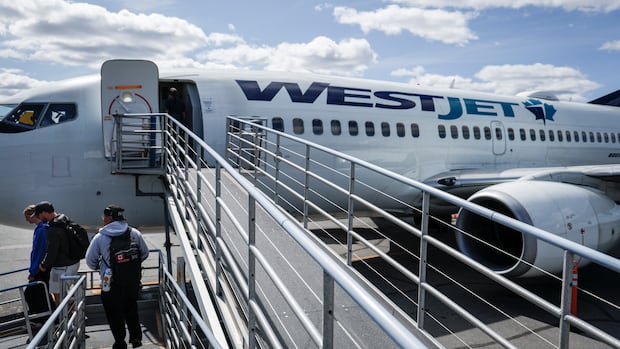
WestJet has been accused of creating an “undue barrier” for travelers with disabilities by effectively preventing certain power wheelchairs from being transported on its flights, according to Canada’s transportation authority.
In a recent ruling, the Canadian Transportation Agency mandated that the country’s second-largest airline must eliminate its 136-kilogram (300-pound) weight limit on mobility devices by July 2027.
The agency recommended that WestJet implement “spreader plates” to better distribute the weight of wheelchairs in the cargo area and consider alternative travel arrangements with other airlines until the weight restriction is lifted.
This issue was brought to the agency’s attention by Steven Fletcher, a Winnipeg resident and former federal minister of state for transport, who was denied boarding with his custom wheelchair on a flight from Winnipeg to Toronto earlier last year.
Fletcher and other advocates argue that the weight cap has limited air travel options across the country and discriminated against individuals with disabilities.
“They have stigmatized, marginalized, and excluded a whole segment of Canadians — through no fault of their own — simply due to an arbitrary figure that lacks justification,” Fletcher stated in an interview with The Canadian Press this week.

Travellers and advocates say a rule at WestJet Airlines, barring some power wheelchairs from most of its planes, discriminates against people living with a disability.
“WestJet should have proactively worked to accommodate power wheelchairs. Clearly, they have done so in the past, as I have flown with them for three decades with power chairs, as have many others.”
WestJet stated it has no comment to offer, as aspects of the situation are still under review by the regulator.
The agency is expected to make a final ruling regarding the advance notice required from passengers using mobility aids when booking with the airline.
-
Airlines don’t have to tell you how much legroom you’ll have on your flight. Here’s what you need to know
-
WestJet reversing move to install tight seating layout
Last year, WestJet, based in Calgary, claimed that the weight limit was crucial for flight safety and that accessibility regulations permitted the refusal of heavier mobility devices.
The airline established the 136-kilogram limit in 2024 following a technical assessment that evaluated the “maximum allowable weight limit per square inch for the cargo holds” of its Boeing aircraft, as noted in a response to a regulatory complaint submitted by Fletcher.
The central issue revolved around what constitutes reasonable accommodation for users of power wheelchairs, with two airlines in Canada asserting that safety and regulations justify their weight restrictions.
Advocates emphasize the significant limitation on mobility for individuals whose wheelchair acts as an extension of their physical body — and note that most airlines have far less stringent regulations.
In Fletcher’s case, he had to use a different wheelchair for his journey, which resulted in pain and pressure sores that necessitated medical treatment, he reported.
Last fall, the parents of a 14-year-old girl from Saskatoon were informed that their daughter could not travel to Mexico for a planned family holiday due to the weight of her specialized wheelchair. Despite having previously flown with WestJet using the same device from Saskatoon, her trip was denied.
The airline mentioned in November that it was collaborating with the family to facilitate their upcoming travel, but indicated that the wheelchair exceeded WestJet’s weight limit “significantly.”
Challenges of Power Wheelchair Restrictions, Advocates Say
According to John Morris, founder of U.S.-based WheelchairTravel.org, no other major airline in North America imposes such a low weight limit for Boeing 737 aircraft — which make up the majority of WestJet’s 200-plane fleet — or similarly sized planes.
However, a similar restriction is enforced by Flair Airlines, a budget carrier based in British Columbia that exclusively operates 737s, as indicated on the airline’s website.
“This policy is essential for ensuring safe loading and secure stowage, adhering to the aircraft’s certified weight limits,” stated customer experience director Duncan Pattillo in an email last year.
At a national summit on air accessibility, Canada’s airlines promised to make flying safer for people with disabilities. The proposed changes include tracking data on passenger experiences, but advocates say they want to see penalties for when things go wrong.
In 2020, American Airlines implemented a similar restriction but later rescinded it following strong public backlash, largely driven by an advocacy campaign led by Morris.
The fact that two of Western Canada’s most significant airlines have restricted a variety of power wheelchairs on thousands of flights each month presents a serious issue, advocates contend.
Many routes are only serviced by one or two airlines. WestJet serves as the only national carrier on the Saskatoon-Calgary and Regina-Edmonton routes, while both WestJet and Flair operate on the Edmonton-Winnipeg route. Busier corridors often include a third airline, such as Air Canada, which is the only option for many individuals with disabilities.
“The ability to travel within your own country is not just an added convenience; it is a fundamental right of citizenship,” Fletcher remarked.

