
A fascinating finding has captured the attention of the scientific community and could enhance our comprehension of life’s beginnings on Earth.
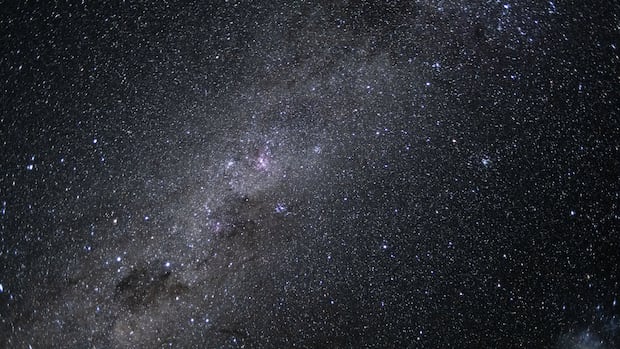
Earlier this month, researchers in Spain discovered sugar located near the Milky Way’s core, approximately 26,000 light-years from Earth.
Employing two radio telescopes, the group at Spain’s Centre for Astrobiology identified a four-carbon sugar within a molecular cloud. This sugar, called erythrulose, is predominantly found in raspberries on Earth and is a common ingredient in self-tanning lotions.
This discovery represents the first instance of a sugar being detected in the interstellar medium, which is a mixture of gas and dust found between stars.
Experts emphasize the importance of this finding because sugars are essential for initiating life on Earth, and the exact process by which sugar molecules first appeared on our planet has puzzled scientists for years.
Sarah Gallagher, director of the Institute for Earth and Space Exploration at Western University, remarked, “The reason it’s so exciting is that these are some of the basic building blocks that you need in order to make nucleic acids, which are essential for life as we know it on Earth.”
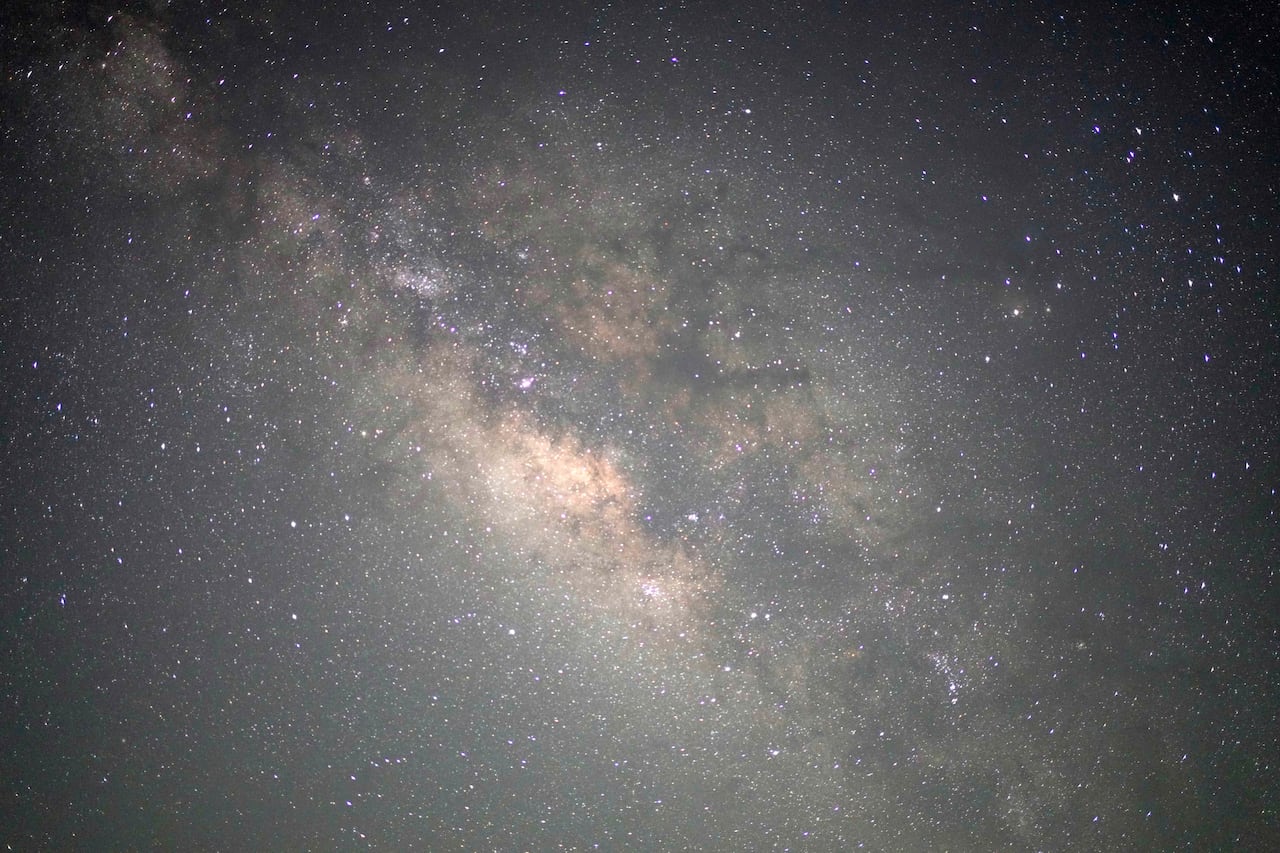
The researchers found a four-carbon sugar in a molecular cloud in what’s known as the interstellar medium. (Jon Gambrell/The Associated Press)
The discovery
Five-carbon sugars form the foundational structure of both DNA and RNA, making them critical in the development of living organisms.
Building on previous studies, including last year’s identification of ribose and glucose in samples from the asteroid Bennu, scientists hypothesize that sugar likely arrived on Earth via comets and asteroids that impacted the young planet.
However, the origins of these sugars have remained uncertain. Gallagher, who was not part of the Spanish research, stated that the source of sugar on Earth was “one of the missing links in terms of understanding where life comes from.”
“And there’s a story now — that [sugars] could come from the giant clouds that stars are born in.”
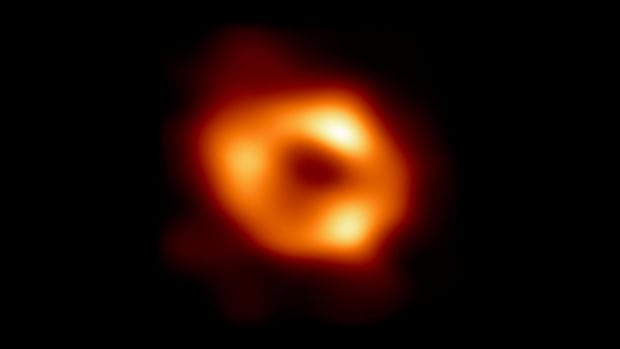
Astronomers using the Event Horizon Telescope have revealed the first image of the Milky Way’s supermassive black hole, named Sagittarius A*.
The Spanish team, under the leadership of Izaskun Jiménez-Serra, determined that they detected sufficient erythrulose in the molecular cloud to estimate that around 50 million tons may have reached Earth’s surface roughly 4.1 to 3.8 billion years ago during the Late Heavy Bombardment.
This controversial theory suggests that the inner solar system’s planets — Mercury, Venus, Earth, and Mars — experienced a “cataclysmic pummelling” by asteroids in their formative years.
The researchers indicated that their findings, published on July 13 in the journal Nature Astronomy, imply that the interstellar medium could serve as a “viable source” of sugar not only for early Earth but also across the universe.
This could pave the way for new discoveries in space related to other sugars and “other crucial molecules for the origin of life.”
-
In our search for alien life, stars might be muddying their signals
-
Canadian-developed technology helps new telescope probe mysteries of the cosmos
How rare is life on Earth?
The research supports the notion that some of the essential materials for RNA formation might have been readily available on early Earth, according to Nagissa Mahmoudi, an associate professor in the Department of Earth and Planetary Sciences at McGill University.
“This is another piece of the puzzle of what was actually there.”
Mahmoudi shared with CBC News that this finding also suggests that comets and asteroids might have carried sugar molecules to other planets.
“That’s the exciting thing. Whenever we think about life on Earth, the big question is: Is life rare here? What’s so special about Earth? Or is it not special? Is life actually everywhere and we just haven’t found it?”
The study reinforces her belief that life may exist beyond Earth.
“We know that these molecules made it here to Earth and they turned into the building blocks of life here, and there’s no reason to think that wouldn’t have happened elsewhere.”

